Advertisement
Staying informed is more important than ever as the situation unfolds with Covid-19. Stay tuned here for our live updates, and be sure to let us know what your business is doing to face this unprecedented challenge.
Covid-19 News Updates
Noxopharm starts trial in COVID-19 treatment race
 "Noxopharm starts trial in COVID-19 treatment race")
Burgeoning medtech company Noxopharm (ASX: NOX) is making strides in the effort race to find a treatment for COVID-19.
The Sydney-based clinical-stage drug development company has filled the first two cohorts for its trial of Veyonda, an experimental anti-cancer drug.
Noxopharm is hoping Veyonda's anti-inflammatory properties could be a vital step in preventing COVID-19 sufferers deteriorating from moderate to severe phases of the disease.
The drug works by helping curb a strong inflammatory reaction known as a cytokine storm by the body's immune system in response to lung damage caused by the virus.
Noxopharm announced plans in April to trial the drug's effect on COVID-19 sufferers. The move had an electric effect on the company's share price, which was languishing at 11 cents.
Since that announcement shares have skyrocketed almost 600 per cent to be trading at 50 cents.
Noxopharm had initially developed the drug for use in treating prostrate cancer, but moved rapidly into the COVID-19 space when Veyonda's anti-inflammatory properties were realized.
The company is planning on launching the study, which is being conducted in the eastern European country of Moldova, in early-November.
Noxopharm CEO and managing director Graham Kelly (pictured) said with the precarious position of many patients in the study, plus not having the benefit of knowing which patients are at risk of progressing, required the company to tread cautiously.
"Hence, we have started with dosages well below where we expect to see any clinical benefit," he said.
"In the cancer setting, 1200mg is what we regard as a minimum therapeutic dose.
"However, cancer is a chronic disease, and we anticipate that in the COVID-19 setting we may have to go up to 1800 mg to address a hyper-acute situation such as a cytokine storm."
Noxopharm's NOXCOVID-1 trial will enrol up to about 40 patients, with enrolment due to be completed before the end of the year.
Patients will be treated with Veyonda for between 14-28 days depending on clinical response.
Updated at 2:35pm AEDT on 26 October 2020.
Victoria reports no new cases of COVID-19 for the first time since June
 "Victoria reports no new cases of COVID-19 for the first time since June")
For the first time since 9 June Victoria has reported no new cases of COVID-19 and zero deaths.
As such, metropolitan Melbourne's 14-day rolling average of cases has fallen to 3.6, and there are just seven cases with an unknown source in the Victorian capital.
The 14-day rolling average in regional Victoria is now down to just 0.2 and zero cases with an unknown source.
The major achievement comes as Victorians have been subjected to months of strict COVID-19 restrictions, designed to drag the state's infection numbers down to what has been achieved today.
Yesterday there were no new cases and no lost lives reported. Cases with unknown source are down, as is the 14 day rolling average in Melb, this remains stable in regional Vic. There is more info here: https://t.co/eTputEZdhs#COVIDVicDatapic.twitter.com/CcLKzwPQHk
VicGovDHHS (@VicGovDHHS) October 25, 2020
It is a bright spot of news for Melburnians who were left disappointed yesterday after Premier Daniel Andrews delayed the announcement of the easing of restrictions.
Andrews said yesterday that the delays were necessary to get on top of an outbreak of COVID-19 in the city's northern suburbs.
Following extensive testing of residents in the northern suburbs since yesterday there have been no new reported cases in the area.
Updated at 9.28am AEDT on 26 October 2020.
Easing of restrictions delayed in Melbourne due to northern suburbs outbreak
 "Easing of restrictions delayed in Melbourne due to northern suburbs outbreak")
COVID-19 restrictions in Melbourne will not be eased today as the state's health authorities work to contain an outbreak of the virus in the city's northern suburbs.
The news comes after six new cases were identified in Melbourne's northern suburbs, meaning there have so far been 39 cases spread across 11 households in the area.
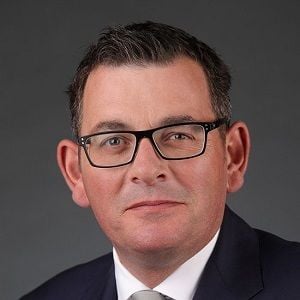
According to the state's Premier Daniel Andrews (pictured), health authorities are not yet aware of how the cases link together.
"I know plenty of people were looking forward to some good news today. And soon, very soon, we'll have some," said Andrews.
"But for now, we need to do again what we've done throughout this pandemic: follow the advice of our public health experts. That means there can be no changes to restrictions in Melbourne today."
Over the last 24 hours more than 3,000 residents of the area were tested for COVID-19.
The Premier hopes to announce further easing of restrictions in Melbourne later this week once the tests results are returned.
"Put simply: this is a couple of extra days that might put us weeks ahead of this virus. To not only get on top of this outbreak but to stamp it out," said Andrews.
"I know everyone will be disappointed we're not making that move today. I get that. I am too.
"But I want to reassure you, this is not us taking a step back. This is us making sure we can take a step forward and stay there."
While today's news will be disappointing for Melburnians the state has announced further easing of COVID-19 restrictions in regional Victoria.
From 11.59pm on Tuesday 27 October indoor gyms and fitness spaces in regional Victoria will be able to open up to 20 people, with a maximum of ten per space and a density of one person per 8 square metres.
Indoor pools will also open to 20 people at a time, and indoor sport will be permitted for those aged 18 and under.
Food courts will also be permitted to resume trading and live music can resume as part of outdoor hospitality.
School graduations will be allowed within school communities and 20 people can gather together indoors for religious ceremonies or 50 people outdoors.
"Regional Victorians should be proud of this success. Everyone should be proud of this success. Because soon, it will belong to our whole state," said Andrews.
The news comes as New South Wales has recorded no new locally acquired cases of COVID-19 for the third day in a row, plus seven cases of the coronavirus in hotel quarantine.
Updated at 12.03pm AEDT on 25 October 2020.
Border opening delays stymie Qantas earnings by $100m
 "Border opening delays stymie Qantas earnings by $100m")
Qantas Airways (ASX: QAN) CEO Alan Joyce claims ongoing state border closures have delayed the airline's recovery, cutting $100 million from earnings in the September quarter with expected impacts for the months ahead.
Joyce told the company's annual general meeting (AGM) today capacity was currently below 30 per cent, but if Queensland's border opens to New South Wales in the coming weeks domestic capacity could rise to 50 per cent by Christmas.
"We know that latent travel demand is strong. We saw that with our 'scenic flight' earlier this month, which sold out in 10 minutes," Joyce said.
"And we saw it when South Australia opened to New South Wales, with 20,000 seats selling across Qantas and Jetstar in just 36 hours," he said.
He added the group's domestic share would likely rise organically from 60 per cent to 70 per cent of the business as Virgin Australia changes its strategy. Meanwhile, Qantas Freight has been performing very well with activity "more in-line with the Christmas rush in recent months".
"Some of this is obviously temporary but Australia Post believes the shift to online shopping has been permanently accelerated and freight volumes will be significantly higher going forward which is a great sign for our exclusive, seven-year deal with Post," Joyce said.
As part of Qantas' deal with Australia Post, it will have the first of three A321 freighters arriving, which carry 60 per cent more than its current 737 freighters and are more fuel efficient.
Chairman Richard Goyder highlighted very encouraging signs from the lifting of some restrictions with New Zealand, as well as the potential for travel bubbles with parts of Asia.
"Both Qantas and Jetstar are keeping a close eye on new markets that might open up as a result of these bubbles - including places that weren't part of our pre-COVID network," Goyder said.
"By early next year, we may find that Korea, Taiwan and various islands in the Pacific are top Qantas destinations while we wait for our core international markets like the US and UK to re-open.
"We're already doing this domestically - adding new destinations that suddenly make sense - and it's the kind of flexibility we need to make the most of any cash positive opportunities in the year ahead."
The chairman discussed the tough decisions that had been made for the airline to survive, including the decision to let go of more than 6,000 people while a review contemplates removing another 2,000-plus roles in ground handling.
With 18,000 of its people remaining stood down and revenue having fallen by $4 billion in the fourth quarter of FY20, the group has nonetheless managed to raise billions of dollars to stay afloat.
"Since March, we have raised over $2 billion in secured and unsecured debt," Goyder said.
"In addition to debt, we secured $1.4 billion through our first equity raising in a decade. I'd like to thank shareholders for their support of this raising, which will power our recovery.
"Importantly, we have the liquidity to manage this. And, because our cash flow from continuing operations is positive before one-offs like redundancies, we could continue at this level of flying for a very long time - if we had to," Joyce noted.
Goyder also drew attention to more than 100 repatriation missions to bring Australians home from COVID-19 hotspots around the world.
"The latest one, from London, is due to land shortly. All flown by crew who volunteer. All handled extremely safely. The national carrier at its absolute best," he said.
Updated at 12:18pm AEDT on 23 October 2020.
Casual job opportunities spike in September quarter
 "Casual job opportunities spike in September quarter")
The number of casual job vacancies in Australia rose by nearly 20 per cent in the September quarter, but the quantity of opportunities overall is still one-third lower than a year ago.
According to the Sunsuper Australia Job Index, which measures and tracks digital job advertisements, the number of casual roles on offer are at a record high.
However the rise in casual opportunities was not enough to offset a general slump in vacancies both permanent and casual, with the index 40 per cent lower than the same period last year.
"Although we've seen a strong recovery in permanent job opportunities this quarter, rising 12.6 per cent, the stronger recovery was actually in contingent or casual work, which rose nearly 20 per cent," said Sunsuper chief economist Brian Parker.
"Also, the ratio of contingent (temporary, fixed term contract and casual) job advertisements as a percentage of total advertisements is now 33.2 per cent, the highest in the history of Sunsuper Australian job index, which highlights employers' preference towards flexible staffing arrangements in uncertain times."
According to the Sunsuper Index there was a large variation in the movement in job vacancies by occupation during the quarter.
Manager and clerical roles grew by 12 per cent and 14 per cent respectively, however this recovery is from a low base and both remain 42 per cent lower than a year ago.
The strongest performing occupational group was education and training, where the number of opportunities rose by 51.6 per cent, albeit off a low base.
Professional job vacancies rose by 25.3 per cent in the last three months, representing the highest volume of job advertisements of all job types.
"It's also worth noting that those occupations showing the higher levels of growth, notably managers, professionals and clerical and administration, have all seen larger increases for contingent vacancies than permanent opportunities," said Parker.
Job opportunities within retail and wholesale rose 11.8 per cent, but remain 51.3 per cent lower than this time last year, while the healthcare industry rebounded strongly with demand for casuals and temps rising 22.6 per cent, although permanent opportunities rose by just 2.6 per cent.
State by state, the most consistent gains were made in New South Wales, up 24.4 per cent in permanent job opportunities and 27.3 per cent in contingent work. However, the number of opportunities in NSW is still down 35.6 per cent year-on-year.
"Victoria did, surprisingly, show improvement since June, particularly in contingent work. After recording solid gains in May, June and July, renewed lockdowns resulted in a sharp fall in the number of opportunities in August before a partial recovery in September," said Parker.
"The rebound in job prospects in the ACT is a more encouraging story for job seekers. The strong growth, particularly in contingent work, means that the ACT, down just 8 per cent on year-ago levels, along with Tasmania (down 9.5 per cent), are the regions to have best withstood the first six months of the pandemic."
Updated at 10.22am AEDT on 23 October 2020.
ABS survey shows improved outlook, but Australian businesses are still just hanging on
 "ABS survey shows improved outlook, but Australian businesses are still just hanging on")
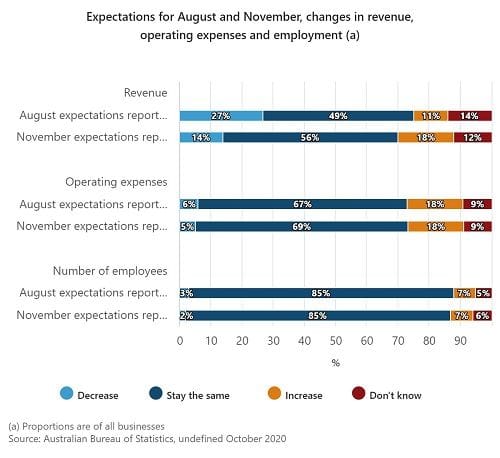
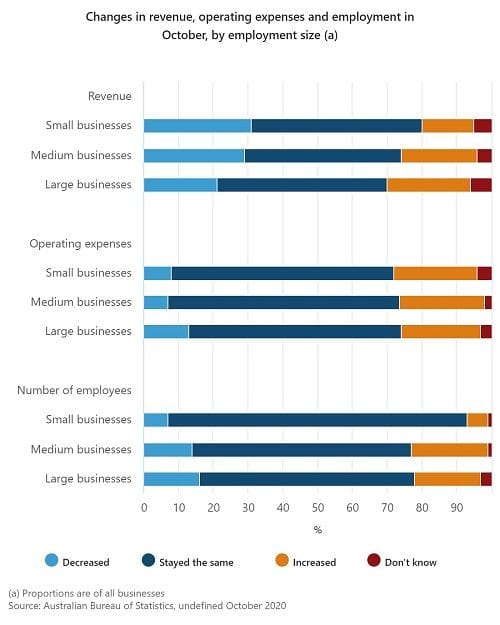
The latest survey from the Australian Bureau of Statistics (ABS) shows fewer businesses are reporting revenue declines compared to July, but the proportion recording rising income remains flat along with cash on hand levels.
Almost half of the businesses interviewed reported revenue declines in July, but that has since improved to just under a third at 31 per cent.
The percentage of respondents who have kept revenue steady month-over-month has risen substantially to 49 per cent, but the share of businesses actually seeing better results remains unchanged at 16 per cent.
Two key signs of recovery in the data include a one percentage point lift in the share of companies with more employees (7 per cent), and a large jump in revenue expectations for the month ahead compared to sentiments back in July.
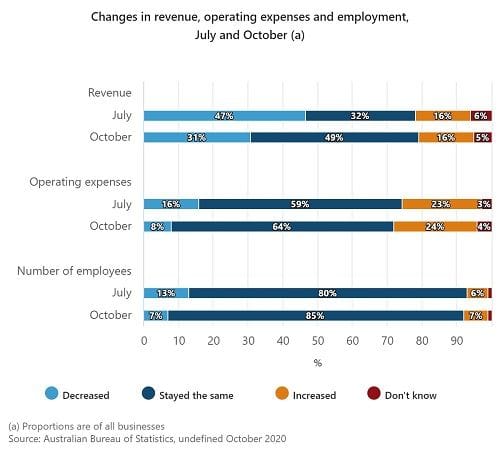
The ABS reports 18 per cent of businesses expected improved revenue in November, compared to just 11 per cent in July when they were looking ahead to August.
Additionally, the proportion of businesses expecting revenue to remain the same rose by seven percentage points to 56 per cent.
Another encouraging sign is that many more businesses actually took the ABS' calls, at 63 per cent of its 2,000-strong sample compared to just half in July.
The statistics agency clarifies that estimates of the prevalence of adversely affected businesses may be an underestimate if they have typically not responded due to negative impacts from COVID-19.
The ABS surveys randomise the selection while accounting for small, medium and large businesses across a diversity of sectors, but the headline numbers don't reveal the significant disparity between different business sizes.
Medium and large businesses have a much higher proportion of respondents reporting new hires at 22 per cent and 19 per cent respectively, and SMEs are much more likely to have seen declining revenue than larger companies.
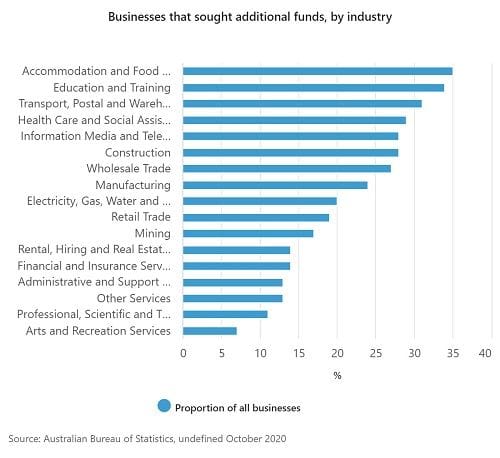
But small businesses have also been less likely to seek out additional funds, at 21 per cent compared to 24 per cent for large businesses and 27 per cent for medium businesses.
The ABS reports similar responses in terms of the amount of cash on hand, with 8 per cent of businesses having enough for less than a month, 21 per cent with enough for under three months, 13 per cent to last up to six months and 38 per cent with sufficient funds to continue for more than six months.
The survey results align well with a recent report from the Australian Banking Association (ABA) that showed repayments had resumed for almost half the nation's deferred loans.
The ABS survey showed the share of businesses deferring loan repayments had fallen by more than half since May, from 16 per cent to 7 per cent, although some industries are suffering more than others such as accommodation and food services, wholesale trade and manufacturing.
Updated at 3:05pm AEDT on 22 October 2020.
MyDeal.com.au is kind of a big deal, enters ASX with a bang
 "MyDeal.com.au is kind of a big deal, enters ASX with a bang")
If there is any sector that symbolises bullish opportunities for a post-pandemic world, it is e-commerce.
Kogan (ASX: KGN) shares have tripled since the start of the year, Temple & Webster (ASX: TPW) shares have quintupled, and traditional retailers that have successfully pivoted online are reaping the rewards.
Even the incumbent global giant Amazon (NASDAQ: AMZN) has seen its shares jump 68 per cent off a very high base since January 2020.
Investors simply can't get enough of the space, so it is unsurprising that household goods e-commerce player MyDeal.com.au (ASX: MYD) started trading today at an 80 per cent premium to its initial public offering price of $1 per share.
Founded in 2011 by Sean Senvirtne (pictured), who now owns 47 per cent of the $465 million listed entity, MyDeal recorded 317 per cent year-on-year gross sales growth to $56.7 million in the September quarter alone.
But in the company's prospectus Senvirtne said the group was only at the beginning of its journey.
The IPO sought to raise funds of $40 million at $1 per share in order to grow MyDeal's private label business that is targeting gross margins of 35-40 per cent, as well as invest in proprietary technology such as app development and advertising to grow the customer base and brand.
At the time of writing this morning, MYD shares were trading at $1.81 each.
"MyDeal has gone through several evolutions since inception including group buying, dropshipping, and we were one of the earliest online retailers in Australia to launch a marketplace," Senvirtne said in the prospectus.
"We have an exciting roadmap of growth opportunities in the short to medium term such as the development of our mobile apps and the expansion of our private label business, however, what I am most excited about is the innovative solutions that we can deliver for our customers and sellers in the future as our marketplace continues to evolve."
RBC and Morgans were the joint lead managers and underwriters of the IPO, Henslow was the company's corporate advisor and Maddocks acted as legal advisor.
"This is a very exciting day for MyDeal, and I am delighted with the strong support that we received from both institutional and retail investors," Senvirtne said today.
"I would like to thank our long-term shareholders for their ongoing support, and welcome new shareholders to be part of the exciting journey ahead of us.
"I would also like to thank the amazing team at MyDeal. It has been an incredible journey, and this milestone would not have been possible without your hard work and dedication."
After recording a statutory profit of $849,232 in FY20, in the first quarter of the current financial year MyDeal recorded 268 per cent year-on-year active customer growth to 669,897.
With more than 1,700 sellers on the platform, the group's main source of revenue is a commission fee for every product and service sold on the marketplace.
The company pushed forward with its private label strategy with the market segment expanding rapidly, including more than 100 products listed for sale across key categories such as furniture and homewares.
MyDeal started selling products under the Duke Living and ErgoDuke brands in June 2020, which racked up $1.6 million in gross sales until the end of September.
Updated at 12:02pm AEDT on 22 October 2020.
Online sales soar 400 per cent for Lovisa
 "Online sales soar 400 per cent for Lovisa")
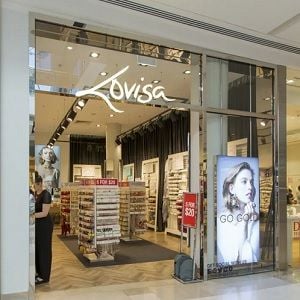
Jewellery retailer Lovisa (ASX: LOV) is glistening at the moment with not just phenomenal growth for its online sales in the first 16 weeks of FY21, but also a significant improvement for its bricks-and-mortar stores globally.
Even though 30 stores in metropolitan Melbourne remain closed with a potential re-opening on the cards for 1 November, global comparable store sales were down just 10.2 per cent in the financial year to date.
This compares to a 32.5 per cent year-on-year decline in the June quarter.
"We have continued to see stronger performance from those markets that have been re-opened longest and with the least restrictions in place, with Australia and New Zealand continuing to be our best performing regions," the group reported in an update today.
"We have seen a large increase in COVID cases across a number of our markets over the past few weeks, in particular in Europe, and continue to monitor these situations, however at the current time all of our European stores remain open."
But the company has also been ringing the figurative online till at an unprecedented rate. Lovisa's e-commerce sales growth stood at 384 per cent in the June quarter, but now that rate has edged even higher to 400 per cent.
"Our execution online remains a key focus to ensure it can become a meaningful part of our business, with digital store fronts now in place servicing all 8 of our major markets around the world," Lovisa said.
However, the improved performance in Australia both for stores and online has meant the company is no longer eligible for the JobKeeper wage subsidy past the end of September.
The expected impact of this development on profitability is likely what pushed LOV shares down 1.15 per cent today to $8.60, but they are still more than three times higher than their lowest price when the pandemic hit.
"Our Global Support Centre and our Australian Distribution Centre are both located in Melbourne and both have continued to function well during the government-imposed lockdown in supporting our global business operations," the group clarified.
"Our strategic plans remain in place, we are ready to continue our store roll out and we continue discussions with our landlords globally as we believe current circumstances will create further opportunities for expansion of our store network, which will be supported by our strong balance sheet with a continued net cash position and undrawn cash debt facilities available to support our ongoing investment in growth."
Updated at 3:55pm AEDT on 20 October 2020.
South east Sydney residents on alert after public health warning issued
 "South east Sydney residents on alert after public health warning issued")
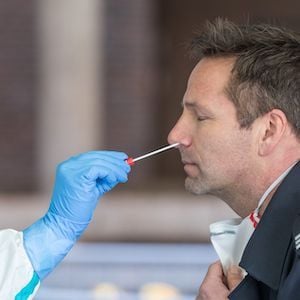
Residents of south east Sydney have been told to monitor for symptoms after a positive case of COVID-19 visited a number of venues and cafes in the Kingsford and Ramsgate areas.
NSW Health says after alerting the public to a positive case of COVID-19 in the area on 15 October it is still investigating the source of the infection and no specific venues of concern have been identified.
However, it is believed the case visited several cafes for short periods of time and ordered takeaway while potentially infectious in the first two weeks of October.
"Anyone who has visited these suburbs, especially cafés, should monitor for symptoms and immediately isolate and get tested should even the mildest of symptoms appear," said NSW Health.
"After testing, you must remain in isolation until a negative result is received.
"NSW is at a critical point, and the only way to find new cases and prevent further transmission is to increase testing. This is particularly important in south eastern, south western, and western Sydney as well as in south western Sydney and western Sydney where there have been recent locally transmitted cases."
Health authorities strongly recommend those in the area to wear a mask when using public transport, rideshares and taxis, and in shops, places of worship and other places where physical distancing is not possible.
NSW reported no new cases of locally transmitted COVID-19 in the latest reporting period to 8pm last night.
The last time there were no new locally transmitted cases in NSW was the 24 hours to 6 October.
Four cases of the coronavirus in hotel quarantine were diagnosed overnight, bringing the cumulative number of cases in NSW to 4,153 since the pandemic began.
In Victoria there was just one new confirmed case of COVID-19 today, which is promising as Premier Daniel Andrews suggested over the weekend that sustained low case numbers could result in further restrictions being eased on hospitality and retail in the state.
Globally the total number of confirmed COVID-19 cases have crossed past the 40 million mark overnight.
Of the confirmed cases, 1.1 million have passed away because of the coronavirus, while 30.3 million have recovered.
India is leading the world in terms of new daily cases of COVID-19 with 55,511 confirmed infections recorded yesterday, followed by the USA with 49,134 new cases of COVID-19.
They are followed by France, the UK and Russia in terms of new confirmed daily cases.
In total the USA has been hit the worst by the coronavirus, recording more than 8.3 million cases of COVID-19 since the beginning of the pandemic.
Updated at 10.20am AEDT on 20 October 2020.
WA Premier delays next easing phase as COVID-positive ship crews pose increasing threat
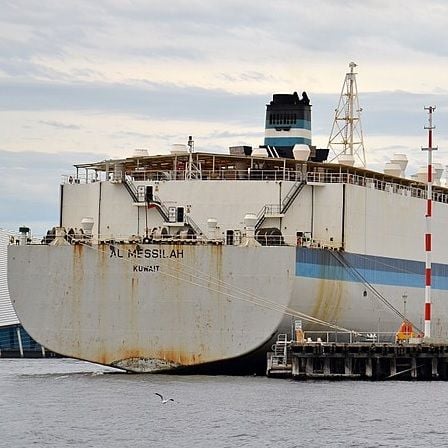 "WA Premier delays next easing phase as COVID-positive ship crews pose increasing threat")
Western Australia was due to enter Phase 5 of its recovery roadmap this Saturday with practically all restrictions removed except its hard border, but heightened threats from overseas arrivals have thrown a spanner in the works.
As the state now goes six months without community spread, health authorities are on alert over the recent entry of New Zealand travellers from other parts of the country, as well as 24 COVID-positive cases for ship workers on a vessel docked at Fremantle.
Premier Mark McGowan highlighted Western Australia was currently one of the most open and free societies on the planet, but its relaxations of internal controls also made it more vulnerable if the hard border were to be breached.
"Western Australia remains more susceptible to a major outbreak given nearly all physical distancing and gathering restrictions have been removed," he said.
Because of these concerns, the state's Chief Health Officer has recommended a further two months be considered for Phase 4 modified measures.
With new modifications to the phase from 11:59pm on 23 October, selected venues with predominantly seated events will be exempt from the two square metre rule.
"They will be permitted to reach up to 60 per cent of their usual maximum capacity for seated and ticketed performances," McGowan said.
"These venues include theatres, concert halls, auditoriums, amphitheatres, cinemas, comedy lounges and performing arts centres.
"These venues have been deemed low risk by the Chief Health Officer as they are seated," he said, adding these new measures would allow these venues and industries the opportunity to function, particularly in the culture and arts sector.
Today's announcements were made against a backdrop of unease in the Western Australian Government over recent developments.
Premier McGowan urged the Federal Government to "slow down" with border bubbles, and noted 23 New Zealand travellers were now in quarantine in the state.
"They will be tested in accordance with our hotel quarantine testing regime for international arrivals," he said.
"Exempt travellers from New Zealand via Sydney or Darwin will be sent to a hotel quarantine though at their own expense.
"A rushed approach to border control is not in Australia's interests. It is not in Western Australia's interest - we need to get back to National Cabinet and find a working solution."
He also revealed test results had just come through from crew members of the Al Messilah ship in Fremantle.
"We have a further 24 positive COVID-19 crew members on the ship currently at Fremantle Port. This is in addition to the one positive case reported over the weekend," he said.
"Obviously these test results are only at one point in time, so it is possible we could get further positive results in the coming days given there are 52 crew on board."
Premier McGowan said it was becoming clear ships arriving with COVID-19 on board are one of the weakest links and biggest risk to WA's way of life.
"This is why we demand the Commonwealth Government step up and work with other jurisdictions on this issue - we need a coordinated international approach to this, and we need our Federal Government to take international action," he said.
"Foreign Affairs is the Commonwealth's responsibility, and the arrival of unwell maritime crew is now fast becoming the most difficult issue for our authorities to manage safely without putting our community at risk."
Photo: Bahnfrend, via Wikimedia Commons
Updated at 2:16pm AWST on 19 October.
Advertisement
Latest News
From $13,000 to $20 million: how a PCOS diagnosis and a pair of scissors built Xali Organics
Inspired by a medical diagnosis and driven by innovative marketing,...
Cedar Woods secures $63.4m in new land acquisitions as record presales underpin pipeline push
Perth-headquartered residential developer Cedar Woods Properties (A...
Australia's long-term beer decline hits home as Lion plans to close Boag's brewery in Launceston
Australia's decades-long decline in beer consumption has claime...
Downer EDI seals $310m Transurban contract to maintain Sydney motorway network
Infrastructure services group Downer EDI (ASX: DOW) has secured con...
Propel Funeral Partners expands New Zealand footprint with trio of acquisitions worth $9.1m
Sydney-based death care provider Propel Funeral Partners (ASX: PFP)...
Advertisement