Advertisement
Staying informed is more important than ever as the situation unfolds with Covid-19. Stay tuned here for our live updates, and be sure to let us know what your business is doing to face this unprecedented challenge.
Covid-19 News Updates
SA defies chief health officer advice, eases restrictions further
 "SA defies chief health officer advice, eases restrictions further")
Social distancing measures imposed on South Australian hospitality operators will be eased effective immediately against the advice of chief health officer Nicola Spurrier (pictured).
As such, operators of hospitality venues in the state will see distancing measures eased from one person per four square metres to one person per two square metres today.
According to the state's police commissioner Grant Stevens the decision was made against the advice of the CHO.
However, the SA Transition Committee determined the change to be appropriate given the resounding uptake of the new QR code check-in system for businesses and venues across the state.
"It was made clear by Professor Spurrier that the preferred way forward and moving into the next phase of this particular response is that we retain social distancing of one person per four square metres across the board, and that we reconsider our position as we move into next week," Stevens said.
"We looked at the performance of the South Australian community in relation to the take up of the use of QR codes, where we are currently over 1.1 million check ins across the state, which is exceptional.
"And also looking at the economic and social factors in relation to the restrictions that are currently in place, and the advice from the Transition Committee as a whole, was that the best course of action would be to move to a distancing requirement of one person per two square metres for hospitality."
Other activities are still restricted to one person per four square metres.
Professor Nicola Spurrier said it was difficult to give the Transition Committee a solid risk assessment at this point in time but she was confident the easing of restrictions could work if the use of the QR code check-in system was taken up across the board.
"Our recommendation from a health perspective was to continue that one per four square metre density requirement and my other advice was that we would reconsider things every couple of days," she said.
"I am providing the best advice that I can and obviously the density requirement in certain venues means that you don't have as many contacts between people. But on the other hand we have the QR readers which really is a game changer."
No new cases of COVID-19 were detected in SA today. There are now just seven active cases in South Australia and 272 people in quarantine.
Yesterday 3,548 South Australians got tested for COVID-19 a low number of tests according to Spurrier.
"That is not really high enough guys, I'd like to see it a little bit higher," she said.
"If you happen to be one of those people with a bit of a sore throat or a runny nose can you please go out and get it done."
Updated at 11.42am AEDT on 4 December 2020.
Aussies to wait for now as UK starts rolling out Pfizer vaccine
 "Aussies to wait for now as UK starts rolling out Pfizer vaccine")
The UK may be ready to roll out the new Pfizer-BioNTech COVID-19 vaccine in the UK, but Australians will have to wait until March for a government-approved program.
The UK government overnight revealed that it will distribute the Pfizer-BioNTech for mass vaccinations from next week as COVID-related deaths in the country edge closer to 60,000. The treatment is said to offer up to 95 per cent protections against COVID-19.
The Medicines and Healthcare Products Regulator Agency in the UK has assessed the vaccine as safe to be distributed next week.
"I'm very proud that the UK is the first place in the world to have a clinically authorised vaccine," British Health Secretary Matt Hancock told the BBC.
Britain will begin immunisations for those most in need, including the residents of aged-care homes. The government has ordered 40 million doses, enough to immunise 20 million people.
"It's the protection of vaccines that will ultimately allow us to reclaim our lives and get the economy moving again," UK Prime Minister Boris Johnson tweeted.
Meanwhile, the Australian government is progressing towards its own vaccination program which is expects will occur early next year.
"Our advice remains that the timeline for a decision on approval is expected by the end of January 2021 and our planning is for first vaccine delivery in March 2021," says Health Minister Greg Hunt.
"Pfizer continues to work with the Therapeutic Goods Administration, providing data for safety and efficacy as part of the approval process."
In preparation for the program the government today is pushing through parliament the Australian Immunisation Register Amendment (Reporting) Bill 2020.
The purpose of the amendment is designed to ensure compulsory reporting of all vaccinations in the Australian Immunisation Register.
Hunt says these changes will ensure that every Australian can access their vaccine history through this safe and secure register and support the administration of COVID-19 vaccines.
"The Australian Government has acted decisively to secure production and supply agreements to secure early access to 134 million doses of a COVID-19 vaccine to Australians in 2021-21 and 2021-22 through an investment so far of $3.3 billion," he says.
"In addition to the significant investment in COVID-19 vaccines, the Australian government invests over $400 million each year though the National Immunisation Program to protect Australians against 17 vaccine preventable diseases."
Updated at 11.13am AEDT on 3 December 2020.
Massive easing of COVID restrictions to set NSW free
 "Massive easing of COVID restrictions to set NSW free")
NSW Premier Gladys Berejiklian has finally set the state free with a wholesale lifting of restrictions across the hospitality and events sector, paving the way for the performing arts community to get back to work.
The changes, which will see outdoor venues able to accept 100 per cent capacity and indoor venues up to 75 per cent, come as NSW continues to record zero cases of community transmissions.
The current rule of one person per four square metres for indoor venues will be eased to one per two square metres. Venue caps also will be removed on events such as weddings and funerals. The only exceptions at this stage are gyms and nightclubs which must adhere to the four-square-metre restrictions.
The changes will come into effect from Monday, 7 December.
"We are grateful to the people in NSW for their patience and understanding over what has been an incredibly difficult year," Berejiklian says.
"The rolling back of restrictions across the state is only possible because of the excellent work of the community who have followed social distancing guidelines and continued to come forward for testing."
The new rules to apply in NSW from next week are:
Venues including hospitality venues, retail and places of worship:
- one person per two square metres (with 25 people permitted before the rule applies), except for gyms and nightclubs (one person per four square metres with a maximum of 50 people allowed in gym classes or on the dance floor at nightclubs).
Stadiums and theatres:
- outdoors: 100 per cent seated capacity, and one person per two square metres for unstructured seating areas
- indoors: 75 per cent seated capacity.
Gatherings in outdoor public spaces:
- up to 100 people for outdoor gatherings (up from 50)
- up to 5,000 people for outdoor events that are fenced, ticketed and seated (subject to the two-square-metre rule)
- up to 3,000 people for other organised outdoor events, such as community sport and outdoor protests (subject to the two-square-metre rule).
Dance floors:
- up to 50 people indoors.
Singing:
- up to 50 performers indoors, no maximum cap outdoors
- advice is for the congregation or audience to continue wearing masks if singing.
Under the changes, maximum capacity caps will be removed subject to the two-square-metre rule for:
- bookings at hospitality venues
- weddings
- funerals
- regional agricultural shows
- corporate events
- religious services.
Deputy Premier John Barilaro says the people of NSW have worked hard to keep COVID-19 under control and deserved this major easing of restrictions.
"Today is a great day for the people of NSW and great timing with Christmas fast approaching, as we will soon see larger crowds at venues and events and the expansion of the two-square-metre rule statewide," he says.
Under the changes, most venues will be able to double their capacity, which will have an immediate and substantial impact on the economy.
"This change will make a big difference to many businesses and will provide a real boost for jobs particularly in the service industry which has been hit hard over the past nine months," says Treasurer Dominic Perrottet.
NSW warns that despite the easing of restrictions, the public needs to remain COVID-safe, urging anyone to get tested and avoid going to work if they have the slightest symptoms, and to continue maintain social distancing.
"It is critical that people continue to come forward for testing and practice COVID-safe behaviour when out and about and catching up with family and friends," says NSW chief health officer Dr Kerry Chant.
Updated at 3.26pm AEDT on 2 December 2020.
FDA fast tracks Mesoblast COVID-19 treatment
 "FDA fast tracks Mesoblast COVID-19 treatment")
A COVID-19 treatment being developed by Australian pharmaceutical company Mesoblast (ASX: MSB) has been granted Fast Track designation by the US Food and Drug Administration (FDA) today.
The designation is for MSB's treatment of acute respiratory distress syndrome (ARDs) - a potentially fatal complication of COVID-19 infection called remestemcel-L.
As a result, the FDA will assist in the development of remestemcel-L and will expedite the review of the drug because it fills an unmet medical need.
Under Fast Track designation, a Biologic License Application (BLA) for remestemcel-L is eligible for both rolling submission and priority review.
In its submission to the FDA Mesoblast highlighted results from a pilot study of remestemcel-L under emergency compassionate use at New York's Mt Sinai Hospital in March-April this year.
In this study, nine of 12 ventilator-dependent patients with moderate to severe COVID-19 ARDS were successfully discharged from hospital a median of 10 days after receiving two intravenous doses of remestemcel-L.
An ongoing Phase 3 trial of the drug in up to 300 ventilator-dependent patients is approximately two thirds enrolled.
Two interim analyses of this trial have been performed by the independent Data Safety Monitoring Board (DSMB), with recommendations to continue the trial.
Receipt of the Fast Track designation comes after Mesoblast entered into a license and collaboration agreement with Novartis for the development, manufacture and commercialisation of remestemcel-L.
As part of the deal Switzerland-based Novartis will make a US$50 million (AUD$68.7 million) upfront payment to Mesoblast.
Following the initiation of a Phase 3 clinical trial, Novartis will fully fund the global clinical development of the drug.
In addition, Mesoblast may receive a total of US$505 million (AUD$694 million) pending achievement of pre-commercialisation milestones for remestemcel-L and a further US$750 million (AUD$1 billion) based on achieving certain sales milestones.
Mesoblast will retain full rights for the use of remestemcel-L for treatment of graft versus host disease.
Updated at 9.58am AEDT on 2 December 2020.
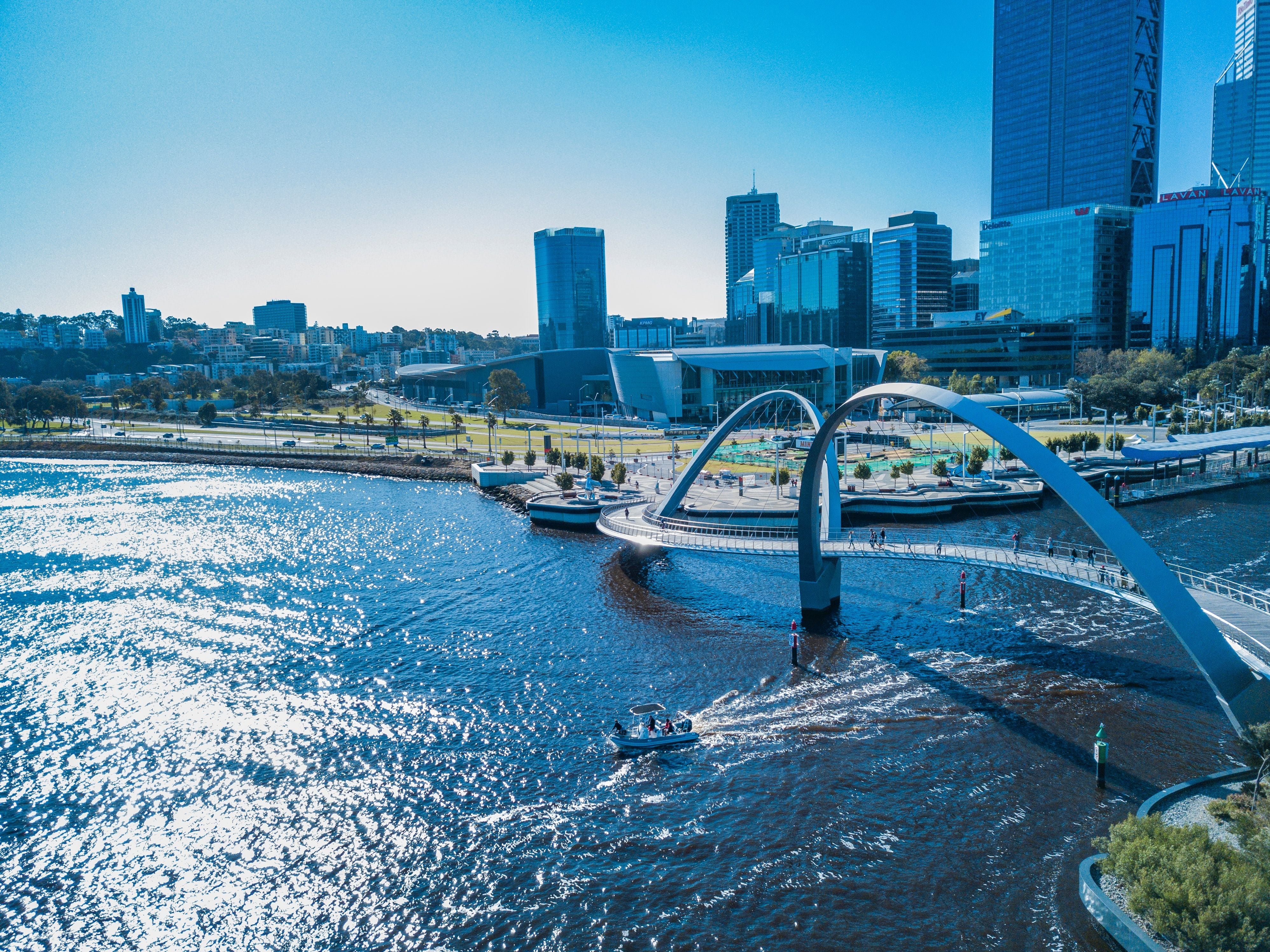
WA border to VIC and NSW to open completely from 8 December
 "WA border to VIC and NSW to open completely from 8 December")
The imposition of two weeks self-quarantine on arrival in Western Australia will no longer be in place for those travelling from Victoria and New South Wales from Tuesday 8 December.
Announced today by Premier Mark McGowan, both VIC and NSW will be classified as "very low risk" states, meaning travellers can enter WA without needing to quarantine for a fortnight from 12.01am next Tuesday.
The move comes after VIC went 28 days with no locally acquired cases of COVID-19 last Friday, with NSW expected to reach that milestone this coming Friday.
It brings the two states in line with other jurisdictions already classified as "very low risk" including the Australian Capital Territory, Queensland, Tasmania, and the Northern Territory.
"It has been a remarkable effort from Victoria, in particular given the position they were in just a few months ago," WA Premier McGowan said.
"It's an outstanding achievement unrivalled around the world.
"Western Australia's border controls have been highly effective in reducing the number of potential cases of COVID coming into WA."
Though travellers from NSW and VIC will no longer have to complete 14 days of self-quarantine on arrival, they will still be subject to a number of restrictions at the border.
These include arrivals undergoing a health screening and temperature test at the border, potentially completing a COVID-19 test if required by WA authorities, and completing a declaration that they do not have symptoms of the virus and detailing which jurisdictions they have been in.
As WA still has a hard border arrangement in place with South Australia, arrivals from NSW and VIC must not have been into SA for 14 days before arrival and must not have knowingly mixed with anyone from SA.
Travel into WA from SA remains prohibited until at least 11 December according to McGowan.
"The controlled interstate border is a careful and cautious approach. It faced its first test only the day after it came into effect due to the concerning outbreak in South Australia," McGowan said.
"I always said we would not hesitate to reinstate the hard border if the health advice recommended it, and that's what we did within hours in response to the situation in South Australia."
WA has also further eased restrictions today, with places of worship now exempt from the one person per two square metre rule.
WA recorded three new cases of COVID-19 today - all returned overseas travellers in hotel quarantine.
It has been 233 days since WA last recorded a locally acquired case of COVID-19.
Updated at 12.33pm AEDT on 1 December 2020.
JobKeeper recipient numbers fall by two million
 "JobKeeper recipient numbers fall by two million")
Green shoots of recovery can be seen in the Australian economy as the number of Australian businesses requesting an extension of wage subsidy JobKeeper fell below forecasts in October.
Treasurer Josh Frydenberg has announced preliminary data shows around 450,000 fewer businesses and around 2 million fewer employees qualified for JobKeeper in October than in September.
The data comes from a re-test of business eligibility for the second phase of the scheme, involving the processing of applications from around 500,000 entities covering more than 1.5 million employees or eligible business participants.
"These preliminary October JobKeeper figures suggest an improvement on the 2020-21 Budget assumption of 2.2 million recipients for the December quarter, with around 700,000 fewer employees/eligible business participants covered by the Payment in October due to their employer no longer meeting the required decline in turnover test," says Frydenberg.
"The lower-than-forecast take-up of the JobKeeper Payment extension in October is further evidence that Australia's recovery from this once-in-a-century pandemic is well underway.
The Federal Government made nearly $70 billion in payments for the 13 JobKeeper fortnights to 27 September 2020.
Treasurer Frydenberg highlights recent economic data shows outside Victoria employment has recovered to be less than one per cent below March levels, with some 650,000 jobs created in the past five months nationwide.
"The Reserve Bank of Australia has recently updated its forecast for the unemployment rate, which it now expects to peak at around 8 per cent, down from its earlier forecast of 10 per cent," he says.
"The effective unemployment rate decreased from 9.3 per cent in September to 7.4 per cent in October, with around 80 per cent of those who lost their job or stood down on zero hours now back at work.
"In Victoria, as restrictions have eased, the effective unemployment rate has fallen from 14 per cent to 10.5 per cent."
Updated at 11:20am AEDT on 30 November 2020.
Quarantine breach sparks new public health alerts for Adelaide businesses
 "Quarantine breach sparks new public health alerts for Adelaide businesses")
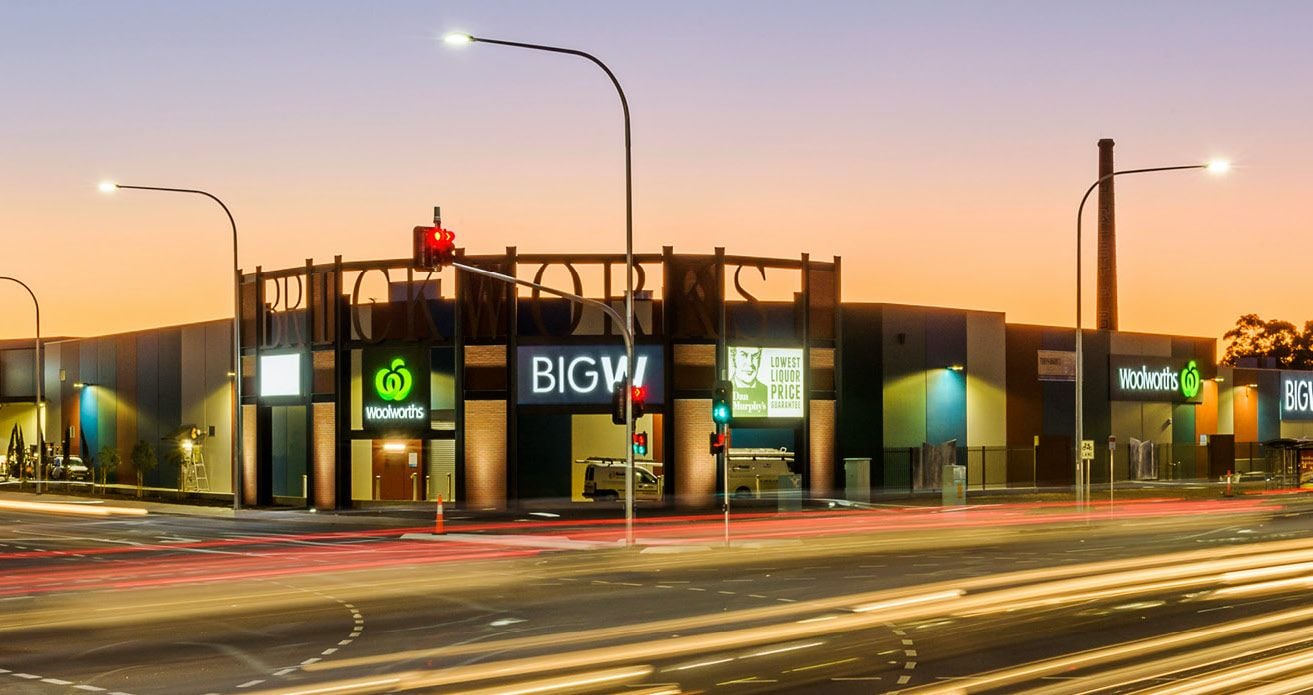
A number of public health alerts have been issued for businesses like Big W, Kmart and Foodland in Adelaide after a positive COVID-19 case breached a quarantine order.
The man was a casual contact of a COVID-19 case and was ordered to self-quarantine, but he breached the direction and later tested positive for the virus.
As such SA Health has asked anyone who attended the below locations to seek testing immediately, even those without symptoms of COVID-19:
- Big W Brickworks, South Rd, Torrensville - Sunday 22 November 12.15pm to 12.50pm
- Flinders University Sturt Campus, Bedford Park - 13 November to 28 November
- Foodland, The Parade, Norwood - Sunday 22 November 1.20pm to 2.00pm
- Kmart, Anzac Hwy, Kurralta Park - Sunday 22 November 2.45pm to 3.10pm
SA Health has established a new pop-up testing clinic near Brickworks in Torrensville.
The clinic, at the Thebarton Community Centre, will be upon from 8am to 8pm, and no bookings or referrals are needed.
SA recorded no new cases of COVID-19 on Sunday, but there are still 17 active cases of the virus in the state.
Updated at 9.23am AEDT on 30 November 2020.
South Australia to ease COVID-19 restrictions from next Tuesday
 "South Australia to ease COVID-19 restrictions from next Tuesday")
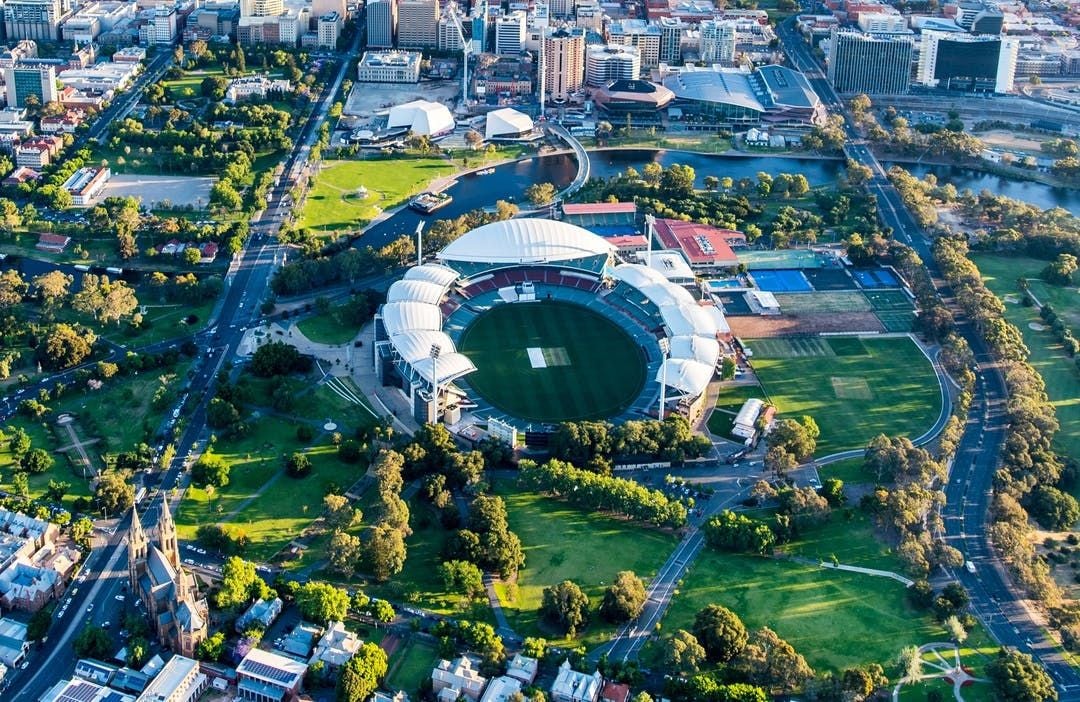
COVID-19 restrictions on venues and gatherings in South Australia will ease from next Tuesday 1 December with an aim to get the state back to "a sense of normality" by Christmas.
The changes will benefit hospitality and venue operators in the state with gathering caps increased, and will stay in place for two weeks so SA Health can monitor the situation.
On the same day all border restrictions with Victoria will be lifted, letting people cross into SA for the first time in months.
From 1 December patron caps on all general trade in licenced premises will be removed, conditional on individual premises deploying SA's new QR code check-in system.
However, the one person per four square metres rule will apply for all indoor activities in venues, and alcohol can only be consumed while seated.
The one person per two square metre rule will come back into play for outdoor spaces at venues, and consumption of alcohol while standing up will be permitted.
A total of 150 people will be allowed to attend funerals, weddings and private functions.
People will be allowed to drink standing up inside at private functions in venues, and dancing will be allowed at weddings.
Home gatherings sizes will remain capped at a maximum of ten people, and gatherings of more than 1,000 people and at nightclubs must have a COVID management plan in place.
Community sport will be able to resume, and masks will be required where physical distancing is not possible.
Internaitonal arrivals suspension extended
A suspension of international arrivals into SA has been extended by a further week until Monday 7 December, but the state's Premier Steven Marshall says he remains committed to the Federal Government's repatriation plan.
There have been no new cases of COVID-19 reported in SA today after a massive 12,322 tests were done yesterday.
"I want to thank every single person in the state for the outstanding effort and contribution," Premier Steven Marshall said.
"This is really a combined effort to do every single plausible thing we can to get back to a sense of normality by Christmas this year."
There are currently 31 cases linked to the Parafield outbreak which sent SA into lockdown for three days last week.
Further, there are just 23 active cases in SA, a reduction on yesterday after SA Health determined a number of infected people had recovered from COVID-19 and were no longer displaying any symptoms.
An air-conditioned pop-up testing clinic has been established at Adelaide's Showgrounds today as the state swelters through a heatwave.
Chief health officer Dr Nicola Spurrier has encouraged South Australians to come forward and get tested if they feel unwell.
"The one thing that every South Australian needs to do in the coming weeks, even if you have only mild respiratory symptoms, is go and get tested," she said.
"If you've already had a test and then a couple of weeks later you start to feel unwell again, go and get another test."
There have been 599 total cases reported in SA since the beginning of the pandemic.
Updated at 12.00pm AEDT on 27 November 2020.
Data from 45 countries show containing COVID vs saving the economy is a false dichotomy
 "Data from 45 countries show containing COVID vs saving the economy is a false dichotomy")
There is no doubt the COVID-19 crisis has incurred widespread economic costs. There is understandable concern that stronger measures against the virus, from social distancing to full lockdowns, worsen its impact on economies.
As a result, there has been a tendency to consider the problem as a trade-off between health and economic costs.
This view, for example, has largely defined the approach of the US federal government. "I think we've learned that if you shut down the economy, you're going to create more damage," said US Treasury Secretary Steve Mnuchin in June, as the Trump administration resisted calls to decisively combat the nation's second COVID wave.
But the notion of a trade-off is not supported by data from countries around the world. If anything, the opposite may be true.
Data from 45 nations
Let's examine available data for 45 nations from the Organisation for Economic Co-operation and Development, using COVID-19 data and economic indicators.
The COVID-19 statistics we'll focus on are deaths per million of population. No single indicator is perfect, and these rates don't always reflect contextual factors that apply to specific countries, but this indicator allows us to draw a reasonably accurate global picture.
The economic indicators we'll examine are among those most widely used for overall evaluations of national economic performance. Gross domestic product (GDP) per capita is an index of national wealth. Exports and imports measure a country's international economic activity. Private consumption expenditure is an indicator of how an economy is travelling.
Effects on GDP per capita
Our first chart plots nations' deaths per million from COVID-19 against the percentage change in per capita GDP during the second quarter of 2020.
The size of each data point shows the scale of deaths per million as of June 30, using a logarithmic, or "log", scale a way to display a very wide range of values in compact graphical form.
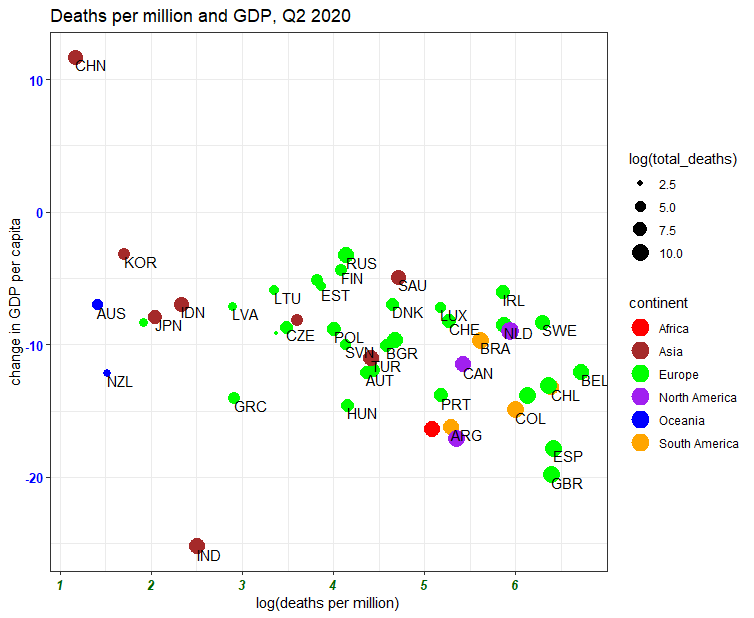
If suppressing the virus, thereby leading to fewer deaths per million, resulted in worse national economic downturns, then the "slope" in figure 1 would be positive. But the opposite is true, with the overall correlation being -0.412.
The two outliers are China, in the upper-left corner, with a positive change in GDP per capita, and India at the bottom. China imposed successful hard lockdowns and containment procedures that meant economic effects were limited. India imposed an early hard lockdown but its measures since have been far less effective. Removing both from our data leaves a correlation of -0.464.
Exports and imports
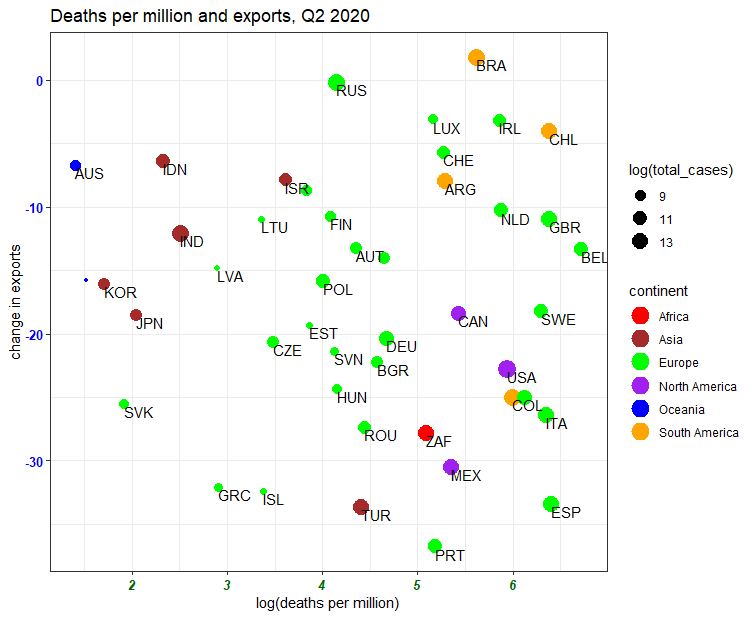
Our second chart shows the relationship between deaths per million and percentage change in exports.
If there was a clear trade-off between containing the virus and enabling international trade, we would see a positive relationship between the changes in exports and death-rates. Instead, there appears to be no relationship.
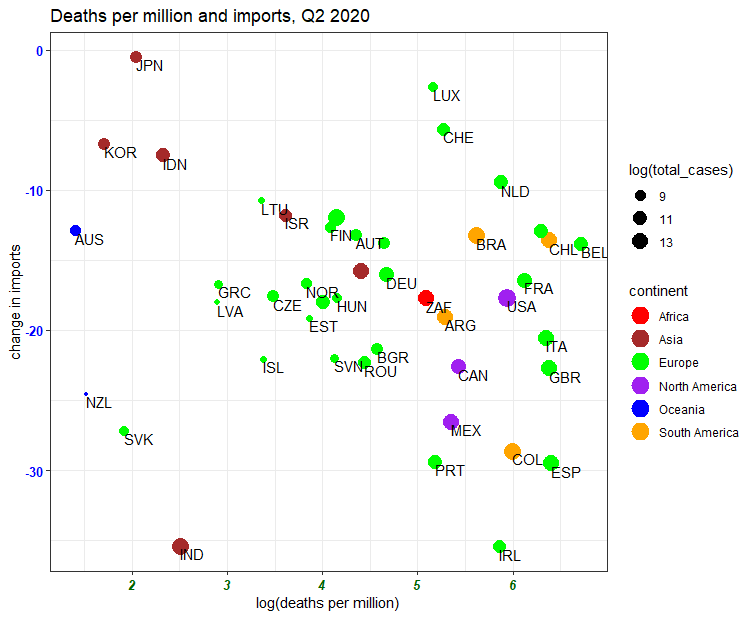
Our third chart shows the relationship between deaths per million and percentage change in imports. As with exports, a trade-off would show in a positive relationship. But there is no evidence of such a relationship here either.
Consumer spending
Our fourth chart shows the relationship between deaths per million and percentage change in private consumption expenditure. This complements the picture we get from imports and exports, by tracking consumer spending as an indicator of internal economic activity.
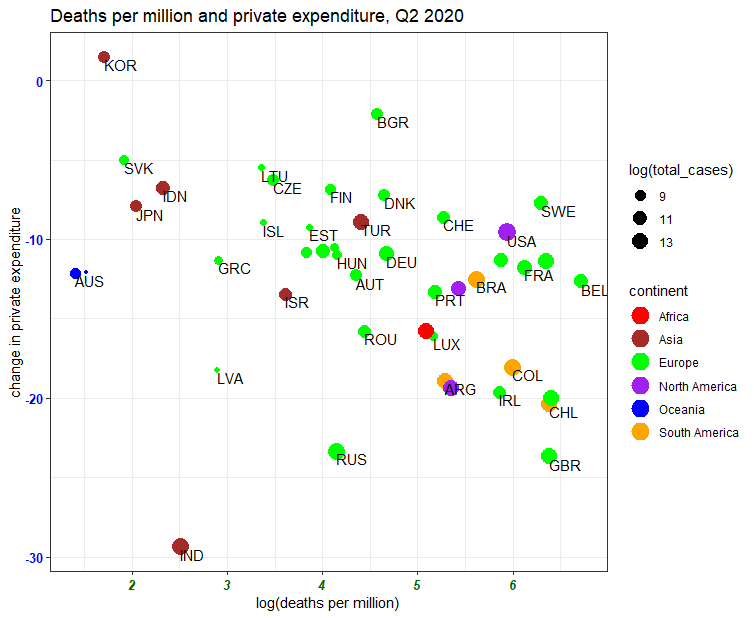
Again, no positive relationship. Instead, the overall negative relationship suggests those countries that succeeded (at least temporarily) in suppressing the virus were better off economically than those countries adopting a more laissez-faire approach.
National wealth
As a postscript to this brief investigation, let's take a quick look at whether greater national wealth seems to have helped countries deal with the virus.
Our fifth and final chart plots cases per million (not deaths per million) against national GDP per capita.
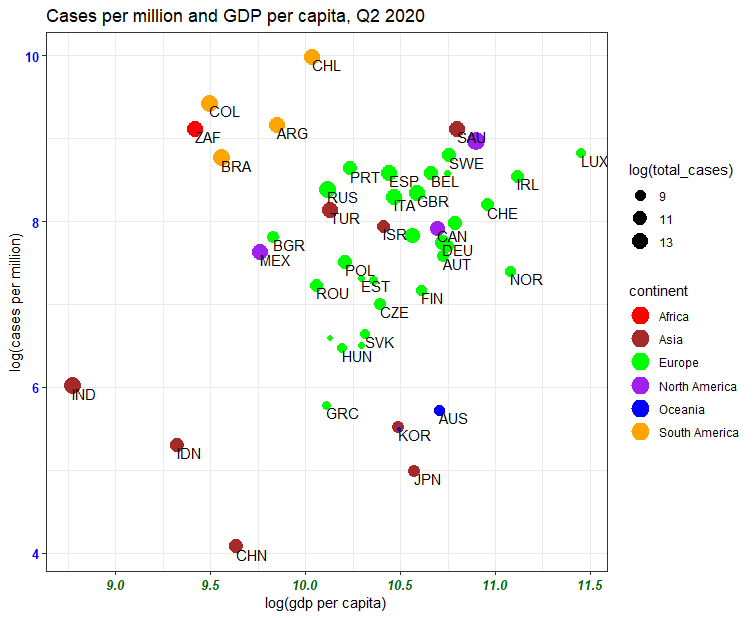
If wealthier countries were doing better at suppressing transmission, the relationship should be negative. Instead, the clusters by region suggest it's a combination of culture and politics driving the effectiveness of nations' responses (or lack thereof).
In fact, if we examine the largest cluster, of European countries (the green dots), the relationship between GDP per capita and case rates is positive (0.379) the opposite of what we would expect.
Read more: Vital Signs: the cost of lockdowns is nowhere near as big as we have been told
It's not a zero-sum game
The standard economic indicators reviewed here show, overall, countries that have contained the virus also tend to have had less severe economic impacts than those that haven't.
No one should be misled into believing there is zero-sum choice between saving lives and saving the economy. That is a false dichotomy.
If there is anything to be learned regarding how to deal with future pandemics, it is that rapidly containing the pandemic may well lessen its economic impact.
Michael Smithson, Professor, Australian National University
This article is republished from The Conversation under a Creative Commons license. Read the original article.
Queensland rolls out the welcome mat to Victoria
 "Queensland rolls out the welcome mat to Victoria")
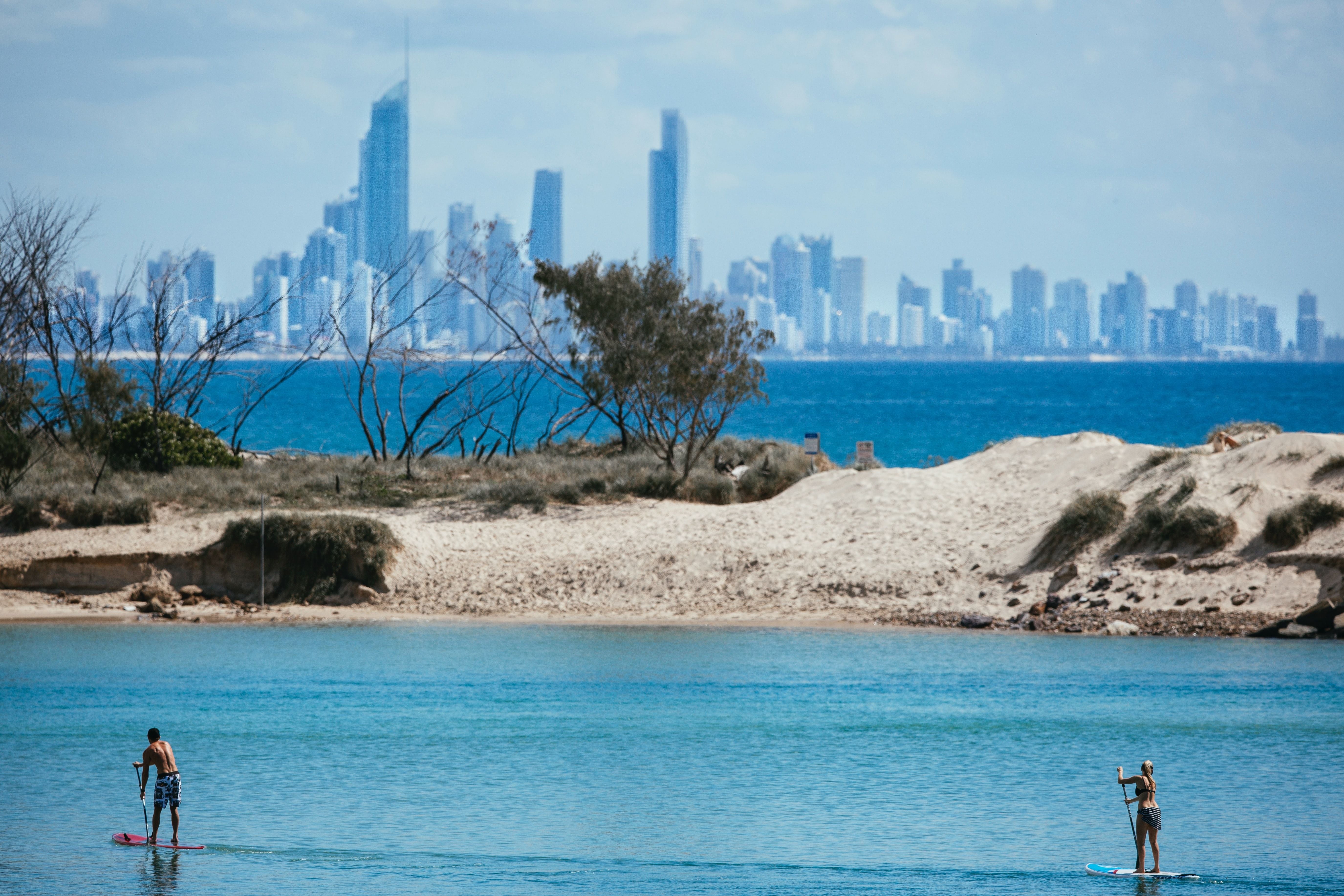
Queensland Premier Annastacia Palaszczuk has announced her state will finally be open to Victorians after the southern state went 28 days without community transmission of COVID-19.
The Queensland border was first completely closed to Victorians on 10 July on fears of an outbreak of COVID-19 that eventually resulted in Melbourne being locked down for months.
Speaking to ABC News Breakfast this morning Palaszczuk welcomed Victorians back to the Sunshine State for the Christmas period.
"I congratulate Daniel Andrews, their chief health officer, and all Victorians because this is just such fantastic news," she said on the program.
"So it means on the 1st of December Victorians can also come to Queensland and, of course, Queenslanders could go to Victoria as well."
The announcement comes one day after the Queensland Government announced those in Sydney would be allowed to cross the border north from 1 December.
Victoria again reported no new cases of COVID-19 and no active cases of the coronavirus in the state today.
The easing of border measures means Victorians will no longer need to complete 14 days of quarantine on arrival, unless they have recently been in a COVID-19 hotspot.
Border restrictions with South Australia are still being considered as the Parafield cluster remains a concern to Dr Young.
Updated at 9.18am AEDT on 25 November 2020.
Advertisement
Latest News
From $13,000 to $20 million: how a PCOS diagnosis and a pair of scissors built Xali Organics
Inspired by a medical diagnosis and driven by innovative marketing,...
Cedar Woods secures $63.4m in new land acquisitions as record presales underpin pipeline push
Perth-headquartered residential developer Cedar Woods Properties (A...
Australia's long-term beer decline hits home as Lion plans to close Boag's brewery in Launceston
Australia's decades-long decline in beer consumption has claime...
Downer EDI seals $310m Transurban contract to maintain Sydney motorway network
Infrastructure services group Downer EDI (ASX: DOW) has secured con...
Propel Funeral Partners expands New Zealand footprint with trio of acquisitions worth $9.1m
Sydney-based death care provider Propel Funeral Partners (ASX: PFP)...
Advertisement