Advertisement
Staying informed is more important than ever as the situation unfolds with Covid-19. Stay tuned here for our live updates, and be sure to let us know what your business is doing to face this unprecedented challenge.
Covid-19 News Updates
Adelaide to trial the return of international students to Australia
 "Adelaide to trial the return of international students to Australia")
Around 300 international students will make their way back to Adelaide, South Australia from early September as part of a pilot test program.
The trial will test how the Federal Government will manage the return of international students to Australia, including quarantine management, testing requirements, and getting students back at universities safely.
The pilot program was announced yesterday in Adelaide by Federal Minister for Trade, Tourism and Investment Simon Birmingham, who stressed the importance of international students for Australia's economic rebound.
"This is a very important next step in terms of the recovery from the economic disaster of COVID," said Birmingham.
"International education is a huge services expert industry for Australia and for South Australia. It underpins many thousands of jobs and it is important that we work out how we can get international students back to Australia safely and appropriately.
"This pilot of around 300 students coming into Adelaide is going to be used to test just exactly how we're going to manage that, but it's being done with the utmost of safety requirements in place."
The students will be flying in from Singapore, while the contingent will also include Hong Kongers, mainland Chinese and Japanese nationals.
Birmingham says Adelaide residents should have no concerns about the potential for COVID-19 to be re-introduced into the city as a result.
"We have successfully demonstrated, particularly in states like South Australia, that we can return Australians from all corners of the world, safely quarantine them, and provide no exposure to the South Australian community in that process," said Birmingham.
"We have to work through these steps very carefully. But that's why a careful pilot program is the right approach to take."
The news comes as exporters in Adelaide were given some good news from Birmingham, with the Minister announcing that new flights out of Adelaide into Doha with Qatar Airways had been secured.
"We're thrilled now to see the additional service flying out of Adelaide into Doha that opens up market opportunities...right across Europe, and indeed frankly around the world by getting back into that key hub," said Birmingham.
South Australian Minister for Trade and Investment Stephen Patterson also welcomed the news of the additional flights out of Adelaide into Doha.
"Today really is another important step forward as Qatar Airways resumes their direct flights from Adelaide into the Middle East," said Patterson.
"That's fantastic news for South Australian producers as it opens them up to one of our emerging markets so that then we can export our high-quality produce such as beef and lamb, and also our seafood into those markets.
"It's also a vote of confidence in the South Australian market itself and the handling of South Australia, how it's gone about its way with the COVID-19."
Updated at 12:15pm AEST on 17 August 2020.
Lendlease reports $310m loss as COVID-19 strangles market conditions
 "Lendlease reports $310m loss as COVID-19 strangles market conditions")
The divestment of its underperforming engineering business and the impact of COVID-19 resulted in property developer Lendlease (ASX: LLC) recording a $310 million loss in FY20.
This marks two years in a row of "disappointing" results from Lendlease, with the major loss representing a 166.4 per cent dive year-on-year following a $467 million profit in FY19.
The majority of the group's woes were experienced in the second half, with COVID-19 impacts contributing to $212 million in losses during the period.
Despite the result Lendlease is still distributing a dividend, with shareholders to secure 33.3 cents per stapled security.
During the financial year Lendlease was supported by $9.7 million in JobKeeper wage subsidies. Globally, the company received $15 million in government support in markets where it was offered.
Lendlease CEO and managing director Steve McCann (pictured) says a number of mitigating actions were implemented to stem the company's losses, including cost reductions, but COVID-19 market conditions ultimately took a heavy toll.
"The group responded swiftly to the onset of COVID-19 with the health and safety of our people and customers paramount, along with measures to strengthen our financial position," says McCann.
"Notwithstanding the challenging environment, the group advanced its strategic agenda in FY20.
"Significant progress was made on growing and converting the development pipeline, including securing additional major urbanisation projects, achieving important planning milestones and creating new investment partnerships to support projects moving into delivery."
The impacts of the COVID-19 pandemic were felt by Lendlease during the second half leading to delays in converting development opportunities and weak trading conditions in its home building segment.
Lendlease says its construction business was most hit in cities where mandated shutdowns were implemented, with effects including lower productivity, projects being put on ice, and delays in the commencement or securing of new projects.
Further, deteriorating market conditions and declining real estate values saw the company's investment portfolio take a hit.
McCann says he has optimism for the company's post-COVID future.
"Our ability to developer urban precincts with a focus on financial, environmental and social outcomes is being recognised globally," says McCann.
"Continued organisation success during the year resulted in the development pipeline more than doubling over the last five years to above $100 billion."
Since June 30 the company has already added a major investment partnership with Mitsubishi Estate to deliver the first residential tower at One Sydney Harbour, Barangaroo South. This project is expected to contribute approximately $100 million to after tax profit in FY21.
"The ongoing conversion of our pipeline provides access to development opportunities and high quality assets for our investment partners," says McCann.
"This integrated approach, along with our placemaking skills, provides a point of difference we believe few can match."
The previously announced $160 million sale of Lendlease's engineering business is expected to complete soon.
Lendlease says it expects the costs associated with the sale of its engineering business will now be $550 million pre-tax, with $525 million accounted for in FY20.
Post-sale Lendlease will retain some major projects including the NorthConnex project in Sydney and the Melbourne Metro Tunnel Project.
Updated at 9:56am AEST on 17 August 2020.
Record profit as JB Hi-Fi leverages lockdown leisure
 "Record profit as JB Hi-Fi leverages lockdown leisure")
Electronics retailer JB Hi-Fi Group (ASX: JBH) had no need for JobKeeper in FY20 as consumers arrived in droves to stock up on entertainment and working from home (WFH) goods, sending net profit after tax (NPAT) soaring by 21 per cent to $302.3 million.
Strong sales momentum continued in July for its Australian and NZ stores along with The Good Guys, but lockdowns in Melbourne and Auckland mean it won't entertain any speculation about results for the current financial year.
Online sales rose by almost half in FY20 to reach $600 million, although the percentage rise was much higher in Q4 at 134 per cent due to the pandemic, bolstered by a consolidation of supply chain and logistics capabilities in Sydney, Melbourne and Brisbane.
The group has also seen a significant acceleration of online sales in Victoria in the first 11 days following the stage 4 temporary store closures, which led to a shutdown of 46 JB HI-FI stores and 21 The Good Guys stores that is currently scheduled to end after mid-September.
But even with this massive growth online sales were just 7.6 per cent of the group's total sales of $7.9 billion, which were up 11.6 per cent.
JB Hi-Fi's Australian operations accounted for the greatest proportion of that $5.32 billion, with their sales growth rate outpacing the group's at 12.5 per cent.
However, it was The Good Guys that recorded the biggest jump in earnings with EBIT up 47.8 per cent to $107.8 million, driven by portable appliances, floorcare, laundry, computers and televisions.
This compares to a 26.2 per cent rise for JB Hi-Fi Australia to $380.8 million, whose leading sales categories were communications, computers, visual, audio and small appliances.
Group CEO Richard Murray says this is a strong result in the most challenging of times.
"We are pleased to report strong sales and earnings for FY20 and importantly, we have provided our customers with the products they required as they spent more time working, learning and seeking entertainment at home, and kept our team members in jobs with an absolute focus on health and safety," he says.
"I would like to recognise and thank our almost 13,000 team members who have done an incredible job in meeting the extraordinary challenges faced during FY20.
"Our customers have continued to turn to us for their technology and home appliance needs and our team members have responded and adapted in an amazing manner to make sure we can meet these needs safely and effectively."
This gratitude to staff was expressed through a $1,000 cash bonus to store and warehouse team members, adusted in accordance with hours for part-timers and casuals.
The company did not receive any wage subsidies from the Australian Government, although it did receive NZD$3 million in wage subsidies from the New Zealand Government while its stores in the country were closed.
Updated at 10:07am AEST on 17 August 2020.
Brisbane's Caxton Hotel hit with large fines after Broncos staff incident
 "Brisbane's Caxton Hotel hit with large fines after Broncos staff incident")
An iconic Brisbane pub near Suncorp Stadium faces $13,344 in fines over two alleged breaches of COVID-19 regulations, one of which involved three Brisbane Broncos coaching staff including NRL legend Allan Langer.
Queensland Police have declined to reveal details of the incidents in question, but the news follows reports of a birthday function held for Langer at the Caxton Hotel that breached the league's biosecurity bubble rules.
Langer and his colleagues Blake Duncan and Ryan Whitley each received $5,000 fines from the NRL over the breach.
"It is important everyone within club bubbles follows the protocols, not only so the season continues, but to ensure no risk to the general community," NRL acting chief executive Andrew Abdo said last week.
Police been investigating that incident and another on the same weekend at the venue.
"The Queensland Police Service (QPS) issued two corporate penalty infringement notices (PINs) to a hotel on Caxton Street in Brisbane in relation to breaches of the public health directions," the QPS said in a statement.
"Officers from Task Force Sierra Linnet commenced an investigation and as a result two corporate penalty infringement notices were issued on Friday, August 7 for two separate incidents.
"Police will allege on July 31 and August 2, the licensed venue failed to comply with COVID-19 public health directions," the police said, adding the fine for each infringement notice is $6,672.
This afternoon the NRL reported Queensland Police had confirmed Brisbane Broncos players had not breached the government's public health directions after attending a venue - reported by the Brisbane Times as the Everton Park Hotel - on 1 August .
This means the players will not need to enter a "COVID Hold" and can continue to train and play while the NRL investigation continues.
All players who attended the venue will however take a COVID-19 test.
The NRL Integrity Unit is continuing to investigate the actions of players at the hotel and has been collecting and examining all available evidence.
Abdo said the league was working closely with Queensland authorities to determine if NRL rules had been breached.
"We are conducting a detailed investigation to ensure we have all available evidence before determining the need for sanctions. It is important we have all the facts and evidence before making a decision," Abdo said.
"Right from the start of this pandemic we have made it clear if protocols are breached players and officials will face strong sanctions. Our actions in recent days have confirmed that.
"Our biosecurity experts have determined the players will not be required to enter a COVID-19 Hold."
Yesterday the NRL proposed Brisbane Broncos player Tevita Pangai Junior be fined $30,000 over multiple alleged breaches of protocols over a period of time.
Pangai Junior has been given a breach notice which excludes him from the Broncos' bubble and any NRL match day.
"We believe this was a case of a player committing multiple contraventions of the protocols and showing a disregard for the league's rules," Abdo said.
"We will do everything we can to protect our season. Players or officials who show they are unable to comply with the biosecurity protocols will be removed from club bubbles until we are satisfied that they will comply with the protocols. We believe in this case, Tevita has not been able to do that.
"This decision protects the health of our playing squads and most importantly the general community."
Updated at 3:36pm AEST on 13 August 2020.
CBD office vacancy rates remain stable during pandemic
 "CBD office vacancy rates remain stable during pandemic")
Australian CBD office vacancy rates have risen modestly in response to the COVID-19 pandemic, thanks to historicially high levels of occupancy in the months leading into the crisis.
According to research from the Property Council of Australia, Australian CBD office vacancy rates increased from 8 per cent to 9.2 per cent over the six months to July 2020, with flat tenant demand overall.
However, vacancy remains below its historic average, with the key Sydney and Melbourne CBDs sitting at less than six per cent.
Vacancies in other capital city markets are stable with Canberra at 10.1 per cent, Brisbane at 12.9 per cent, Adelaide at 14.2 per cent and Perth at 18.4 per cent.
Property Council chief executive Ken Morrison said the previous record low rates of vacancy in the biggest CBD office markets provided a strong buffer against the initial impact of COVID-19.
"The impact of COVID-19 on our CBDs and office markets is still at an early phase, but so far the pandemic has had only a modest impact on vacancy rates," says Morrison.
"Vacancy rates have increased over the past six months, but tenant demand has so far been flat, not falling, and overall vacancies are still below the historic average.
"It's a reminder that office markets have been resilient in the first stage of the pandemic, despite the fact that many office workers have spent months working from home."
The vacancy rate for the Sydney CBD was 5.6 per cent (up from 3.9 per cent in January) and the Melbourne CBD vacancy was 5.8 per cent (up from 3.2 per cent in January).
Melbourne CBD vacancy was most significantly impacted by a 4.6 per cent increase in additional office supply, while the Sydney CBD vacancy was most influenced by 1.2 per cent reduction in tenant demand.
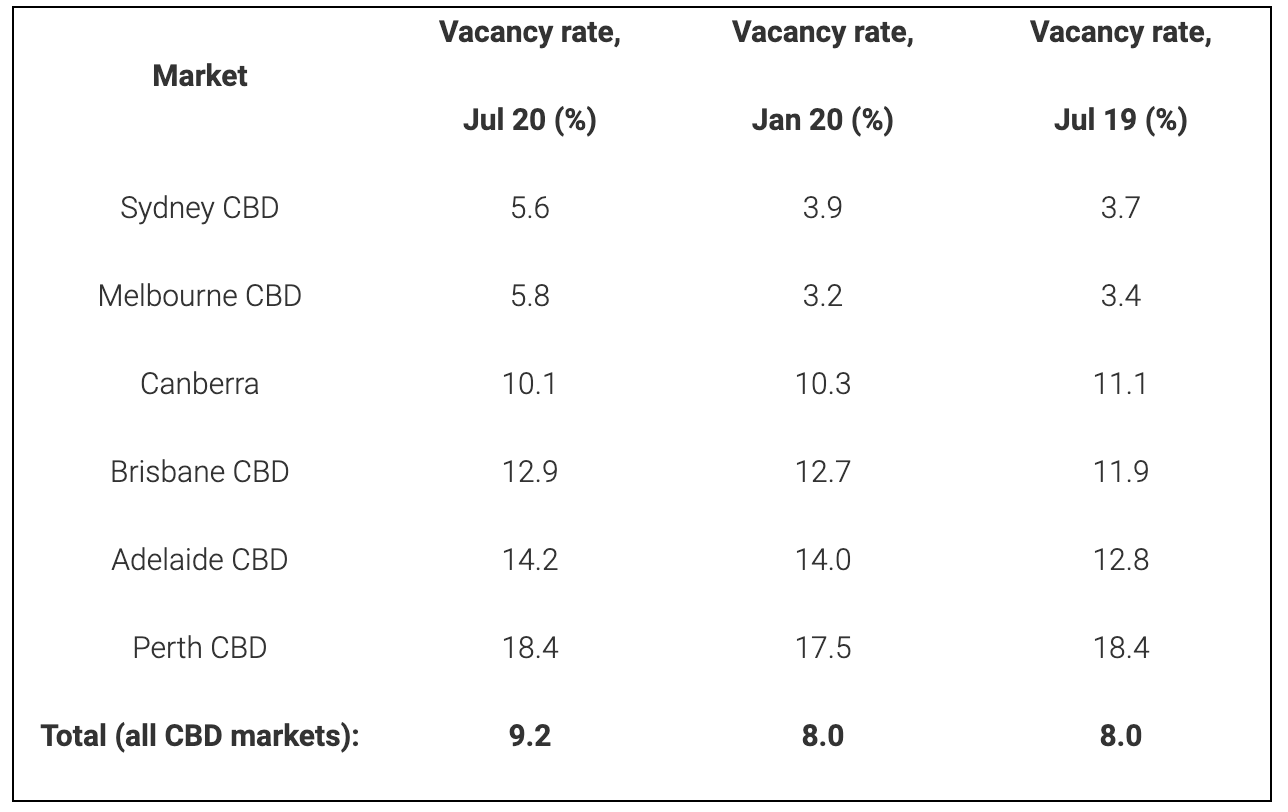
In the non-CBD markets a similar story played out, with vacancy rates increasing from 9.2 per cent to 10.3 per cent.
Though the COVID-19 pandemic forced many Australians to experience working from home for the first time, Morrison says this trend is temporary and unlikely to result in the forecast "end of the office".
"While there is plenty of commentary about the end of the office, the data doesn't suggest this and there is a long way to go as business works its way through the economic and social impacts of COVID-19," says Morrison.
Almost 400,000 square metres of new office space will come onto capital cities markets in the remainder of this year, with the Melbourne CBD will account for 48 per cent of this space, of which 82 per cent is already pre-committed.
In addition, the Property Council says almost 1.2 million sqm of office space will be supplied in CBD markets over the next two and a half years.
Vacancy low for premium space in Sydney
While the Sydney CBD recorded its lowest level of demand in 11 years for the six months to July 2020, vacancy generally remains tight for premium office space.
"Sydney's office market has traditionally been very tight and recorded some of its lowest vacancy rates in the past couple of years, which has put us in a better position to navigate the challenges of the COVID-19 pandemic being felt right across the property industry," says Property Council of Australia's NSW acting executive director Belinda Ngo.
"Tenant demand fell by 58,675 sqm over the six months with most of this occurring in B-grade office space, whereas there was slight positive demand for Premium space.
"We saw some new supply enter the Sydney CBD with more to come over the next two years. There is 117,161sqm of new stock due to enter the market in the second half of 2020, and a strong pipeline of new office stock planned for 2021and 2022."
Vacancy rises in Melbourne for the first time in four years
Melbourne's CBD office vacancy rate hit 5.8 per cent at the end of July, the first rise in four and a half years.
The Property Council says the increased rate is not due to falling demand, but a confirmation of significant developments opening.
"It is simply too soon to tell what the impact of the pandemic will be on the office market, but Melbourne started from a very strong position," says Property Council Victoria executive director Cressida Wall.
"Coming off the lowest vacancy rates in the city's history prior to the pandemic, it is likely that demand will remain strong, notwithstanding Melbourne's temporary shift to home-based working.
"While we all deal with this significant public health situation, it is not too early to put plans in place that reanimate the Melbourne CBD and provide a sense of safety and comfort for office employees when they return."
Adelaide hot property as the most "liveable" city
COVID-19 has only had a moderate impact on Adelaide's office market, with vacancy increasing marginally from 14 per cent to 14.2 per cent.
The city saw 11,530sqm of new commercial office space come online over this period. A-Grade office stock was the most popular asset class, with vacancy dropping from 11.3 per cent to 10.8 per cent in the six months to July 2020.
The Adelaide City Fringe also recorded an increase in vacancy from 14.2 per cent to 14.4 per cent, primarily due to negative demand.
"Adelaide has demonstrated over the past six months that it is a comparatively safe, healthy and resilient capital city, with a growing number of competitive national advantages," says Property Council SA executive director Daniel Gannon.
"When it comes to which capital is Australia's most liveable city at the moment, Adelaide wins hands down.
"Occupancy rates in the CBD are strong and increasing, businesses are building momentum and investors are still looking for reliable places to park capital."
Brisbane and Gold Coast in line with national trends
The CBD office markets in South East Queensland have remained stable during the COVID-19 pandemic period, with the impacts mirroring what's happening on a national scale.
Vacancy in Brisbane CBD increased from 12.7 to 12.9 percent over the past six months", says Property Council Queensland executive director Chris Mountford.
"It was a very similar story in the Brisbane fringe market with vacancy increasing from 13.6 to 14.2 percent.
On the Gold Coast vacancy increased marginally from 12.8 per cent to 13 per cent, driven by negative demand for space.
Perth market remains resilient
With Western Australia more or less isolated from the health crisis ongoing in Australia's eastern states Perth's office market has emerged relatively unscathed.
In Perth the overall vacancy rate for the six months to July 2020 was 18.4 per cent, in line with a year ago, and only slightly higher than the January 2020 vacancy rate of 17.5 per cent vacancy.
Property Council WA executive director Sandra Brewer said Perth's Premium and A-grade office continued to perform strongly but vacancies rose in the lower grades.
"Perth and Adelaide was the only capital cities in the country to report a reduction in space available for sublease," says Brewer.
"Perth's CBD market, which was thought to be on the cusp of a turnaround before the pandemic, has so far experienced relatively moderate effects. The industry will be monitoring tenant demand and sublease vacancy over the next six months as the economic impact of the pandemic plays out."
Updated at 12:08PM AEST on 13 August 2020.
Flight Centre forecasts $875m loss
 "Flight Centre forecasts $875m loss")
Flight Centre (ASX: FLT) has tightened its belt and corporate clients are spending more than expected, but the pandemic's toll has shown its jetlagged weary face with the travel company anticipating a loss before tax of $825-875 million in FY20.
This will likely represent more than a $1 billion shift in the negative from Flight Centre's FY19 result, or more than its recent $700 million capital raise, $200 million debt facility increase and Melbourne HQ sell-off combined.
Before the virus became a pandemic and led to widespread travel restrictions, in the eight months to February the group had achieved a profit before tax of $150 million.
On an underlying basis the performance for FY20 would have been around $350 million higher if it weren't for around $110 million in COVID-related costs to reduce monthly cash outflows, as well as costs arising from supplier failure, impairment charges, write-offs against goodwill and other one-off factors.
The Brisbane-based company took drastic steps to reduce costs over the last few months, slashing its number of leisure shops in half, negotiating rent reductions for remaining stores and placing 70 per cent of its staff globally on government stand-down/furlough programs or in redundancy.
"COVID-19 and, specifically, the government responses to it have clearly had devastating impacts on businesses worldwide and on the airline, travel, tourism and hospitality industries in particular," says FLT managing director and co-founder Graham Turner.
"This has severely impacted us and our people and some very tough decisions have been made over the past four or five months."
Flight Centre's goal was to reduce monthly net operating cash outflows from their pre-COVID levels of $230 million down to $65 million, but this was surpassed by keeping the figure down to $53 million.
The outflow was lower still when considering a $10 million per month net benefit from the JobKeeper program for Flight Centre's retained employees in Australia.
Recent developments such as the Melbourne property sale, a government-backed UK loan and ongoing eligibility for JobKeeper are expected to extend to add $200 million to the group's $1.15 billion "liquidity runway" as at 30 June.
Revenue was higher than anticipated in July at $17 million, mostly fuelled by the company's corporate business which was also a fast-growing segment leading up to the crisis with previous annual TTV of more than $10 billion.
Total transaction value (TTV) exceeded $200 million globally for the month and approached $100 million in Australia.
"Despite ongoing restrictions, revenue has now started to increase, particularly in Europe, and we have surpassed our initial cash flow target, thereby extending our liquidity runway," says Turner.
"We have also continued to win a record amount of new corporate accounts, while generating an underlying corporate profit during FY20.
"This highlights both our corporate business's resilience and its strong future growth prospects in this large, global travel sector which was estimated to be worth $US1.5 trillion per year pre-COVID-19."
Turner says there are still further challenges to be overcome as well as ongoing uncertainty about government COVID-19 objectives and strategies.
"It is critical that businesses across all sectors know these objectives and data lines for COVID-19 control and the lifting of restrictions - whether the end goal is community immunity, suppression, eradication or learning to live with this virus," he says.
"Learning to live with the virus involves protecting the vulnerable, particularly the elderly, while ramping up testing, contact tracing and ultimately isolation so we don't overwhelm intensive care units.
"Adopting this approach, while continuing to take sensible health precautions, flattening the curve and getting society and business back to a reasonable level of normality must be priorities to reduce the already dire economic outcomes being experienced."
Updated at 10:04am AEST on 13 August 2020.
Sydney pub slogged with $10k penalty for "complete disregard" of COVID-19 restrictions
 "Sydney pub slogged with $10k penalty for \"complete disregard\" of COVID-19 restrictions")
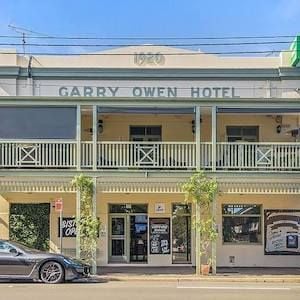
The Garry Owen Hotel in Rozelle, Sydney, has been labelled the "worst pub seen so far" by NSW authorities and hit with $10,000 in fines for breaches of COVID-19 restrictions.
As alleged by Liquor & Gaming NSW Director of Compliance Dimitri Argeres, when inspectors arrived at the Garry Owen Hotel there were only three staff in the whole venue despite being "packed" with patrons.
"The list of breaches grew from there," says Argeres.
"In fact the venue was essentially being operated as though there were no restrictions in place," Mr Argeres said.
Inspectors further allege that:
- The business wasn't registered as COVID safe.
- It didn't have an up to date COVID-19 Safety Plan.
- Sign in procedures weren't enforced.
- Inspectors observed a lack of hygiene processes.
- Customers were standing and mingling while drinking.
- Physical distancing was not enforced.
"The venue was letting down its workers, the community, and all the other businesses trying to do the right thing to keep their doors open," says Argeres.
"Hospitality venues cannot disregard these requirements. If we visit again and observe further breaches, at this premises or any others that have already been fined, they may be temporarily shut down.
"Now is not the time to be facilitating mingling among strangers, let alone allowing patrons to stand on your pub balcony sculling beers."
This week Liquor & Gaming has issued six more fines, SafeWork NSW one, and NSW Fair Trading one, bringing the total number of fines issued by the Department of Customer Service to 29, venues to 27, and the dollar amount to $152,500.
These eight venues were fined this week for breaches related to not having a COVID-19 Safety Plan; non-compliant record keeping; improper hygiene; and a lack of appropriate physical distancing, including in gaming rooms:
- Garry Owen Hotel Rozelle
- Riverview Hotel Balmain
- Dry Dock Hotel Balmain
- Padstow Park Hotel Padstow
- Padstow Bowling Club Padstow
- Marrickville Ritz - Marrickville
- Royal Hotel Randwick
- Yai Thai Gosford
"If you want to continue operating, if you care about the health of your community, then take responsibility for safety in your space," Argeres said.
"This goes for customers too. If you visit a business, follow its rules. If it doesn't look like it has adequate COVID safety measures in place, avoid it."
The news comes as Australia suffers through the deadliest day during the pandemic so far, with Victoria reporting 21 deaths from COVID-19.
There have also been 428 new cases of COVID-19 detected today in Australia, including 18 in NSW and 410 in VIC.
Public health alerts issued in Sydney, returning residents have quaranteine fee waived
NSW Health has issued a range of new public health alerts today, including for an Ikea store, two shopping centres, and a Baby Bunting store.
Because of NSW Health's concern about community transmission the authority has asked anyone who attended the following venues during the dates and times below to monitor for symptoms, and if symptoms present, however mild, isolate and get tested:
- Rhodes Ikea on 8 August, between 1:20pm -2:20pm
- Parramatta Westfield on 5 August between 4pm-5:30pm and 8 August between 12pm 1pm
- Dooleys Lidcombe Catholic Club from 5pm on 7 August to 1:30am on 8 August
- Castle Towers Shopping Centre on 7 August between 3:30pm 5pm
- Baby Bunting, Penrith on Saturday 8 August between 1.15pm - 1.45pm
In addition, the NSW government has decided to waive the hotel quarantine fee for NSW residents returning from Victoria to ease the financial buden on returnees.
The charge will be waived retrospectively and apply to NSW residents already in hotel quarantine after travelling from Victoria.
Updated at 3:26pm AEST on 12 August 2020.
1300 Smiles emerges from shutdowns with higher profits "than ever before"
 "1300 Smiles emerges from shutdowns with higher profits \"than ever before\"")
Shares in Townsville-headquartered dental group 1300 SMILES (ASX: ONT) continued their bull run today to reach pre-pandemic levels, following a 22 per cent lift in EBITDA to $16.2 million for FY20.
Around $1.27 million of that EBITDA can however be explained by JobKeeper, which appears to have kept the group going during closures and prepared to rebound when patients started to return from mid-May onwards.
While revenue was down slightly to $57.1 million and net profit after tax (NPAT) decreased 8 per cent to $7.1 million, managing director Dr Daryl Holmes (pictured) claimed the true strength of the business model had shone through a severe test of its operations.
"We have emerged from a lengthy shutdown with a business that has rebounded to higher levels of revenue and profit than ever before," he said in a letter to shareholders today, also explaining the company does not have facilities in any of the current hotspots.
Dr Holmes noted revenue was greatly reduced during the period of maximum economic restrictions between 23 March and 11 May, with many practices closed while others had their activities sharply limited.
"Subsequent to 11 May our revenue rebounded sharply, with the month of June 2020 delivering our highest monthly revenue ever, by a big margin," the executive said.
"The results for the quarter, the second half, and the full year mask the fact that we've been through a terrible spell which extended over several weeks, followed by an extremely positive period which lasted right to the end of the financial year and has continued without pause through the end of July.
"On a quarterly basis, revenue in 2020 exceeded revenue in the previous year in each of the first three quarters. Over the first three quarters, revenue was up by more than 7 per cent over the previous year."
Following these encouraging results, the board decided to give shareholders a 3 per cent lift in dividends to 12.5 cents per share, which likely contributed to the six per cent lift in today's share price.
He explained the COVID-19 pandemic had led to many weaker players simply leaving the market, which has improved 1300 Smiles' competitive position considerably.
"First of all, our facilities inspire confidence in our patients. Our practices are bright and clean, obviously sanitised and disinfected to the highest standard," Dr Holmes said.
"Our scheduling systems mean that patients spend minimal time in our waiting areas. Our equipment is modern and professionally maintained.
"We were equipped to prevent disease transmission long before COVID-19 came along, and the presentation of our facilities is reassuring to patients."
He described an "unprecedented flow" of both returning and new patients since June.
"Why so many new ones? I speculate that the presentation of our facilities gives people comfort. I speculate that many people who have previously not prioritised their dental and overall health, have reconsidered their life priorities.
"I also speculate but cannot yet measure another effect of COVID-19: it appears that a number of older dentists have kept their practices closed while they consider whether to resume operations at all.
"Along with the flood of new patients, we have also enjoyed an unprecedented stream of applications from qualified dentists wishing to join our practices."
Never miss a news update, subscribe here. Follow us on Facebook, LinkedIn, Instagram and Twitter.Business News Australia
NT border closed for a further 18 months
 "NT border closed for a further 18 months")
The Northern Territory's hard border restrictions will stay in place for at least a further 18 months and will close to Victoria indefinitely according to Chief Minister Michael Gunner.
The lengthy extension of COVID-19 border restrictions has been implemented to protect the Territory's vulnerable Indigenous population, and extra police will be recruited to maintain these barriers.
As a result, the NT will be closed to anyone in a designated COVID-19 "hotspot", which currently includes all of Sydney and Victoria.
Just last week the NT removed a number of "hotspots" from its list, allowing those from Brisbane, Ipswich, Logan, the Blue Mountains and Eurobodalla Shire to enter the jurisdiction without completing a mandatory two-week period of quarantine.
Travellers from Sydney and Victoria are still required to complete a two-week quarantine at their own expense upon entering the Territory and must also sign a border declaration pass.
Chief Minister Gunner described the 18-month timeline as "conservative" on ABC Radio this morning and told all Territorians to "cancel their Christmas holiday plans" to limit the spread of COVID-19.
The announcement comes as Australia reported 353 new cases of COVID-19 today, including 331 in Victoria and 22 in NSW.
Today, for the second day in a row, Victoria confirmed 19 new deaths attributed to COVID-19, bringing the country's total number of deaths to 332.
Updated at 4:00pm AEST on 11 August 2020.
SCA Property profits fall as specialty retailers struggle to pay rent
 "SCA Property profits fall as specialty retailers struggle to pay rent")
Supermarkets have benefited from consumers flooding small suburban shopping centres during the pandemic, but the rising tide did not lift all boats.
Results released today by Shopping Centres Australasia Property Group (ASX: SCP) show even a 5.1 per cent sales increase for anchor supermarket tenants in its community malls was not enough to offset the difficulties faced by specialty retailers.
SCA is reporting a 22 per cent year-on-year drop in net profit after tax (NPAT) to $85.5 million, even though on most metrics its performance was strong; high portfolio occupancy, increased leasing activity, lower vacancies, more renewals and even a profit on the sale of a Victorian property.
Chief executive officer Anthony Mellowes says the company's convenience-based centres have been relatively resilient and have even received increased turnover rent from anchor tenants.
Approximately 92 per cent of tenants are now open and trading, including approximately 63 per cent in Victoria.
While SCA's suburban shopping-leveraged business model does have its advantages, there is no escaping the economic reality of the 52 per cent of tenants who run specialty stores, even if their goods and services are non-discretionary.
Mellowes says the COVID-19 pandemic has impacted many of these tenants who have experienced sales declines.
"We have provided rental assistance to over 600 tenants in accordance with the Mandatory Code of Conduct," he says.
"Our rental collection rate was 77 per cent during the COVID-19 period, and we will continue to pursue payment from tenants of all of the outstanding amounts not covered by agreed waivers or deferrals.
"Our focus continues to be to improve the tenancy mix in our centres with a bias toward non-discretionary categories, to maintain high retention rates on renewals, and to maintain low specialty vacancy by working pro-actively with our tenants in these challenging times."
SCA has estimated a COVID-19 earnings impact of $20.5 million and an $87.9 million decrease in the like-for-like valuation of investment properties.
Of that coronavirus-related impact, $14.4 million comes from an incremental expected credit loss allowance against rental arrears, $4.5 million is in waived rent that is not included in rental income, and around $1.6 million is from additional expenses relating to the pandemic such as cleaning and security.
"The direct impact of COVID-19 on FY20 FFO (funds from operations) is $20.5 million, with the largest contributor to this being expected credit loss allowances due to increased rental arrears," says CFO Mark Fleming.
"In addition, the like-for-like valuation of our investment properties decreased by $87.9 million with $27.4 million of that decrease due to the expected impact of the COVID-19 pandemic on FY21 cash flows.
"In response to the COVID-19 pandemic we raised $279.3 million of new equity in April and May 2020 through an institutional placement and a unit purchase plan," he says, adding this was aimed at strengthening the balance sheet and having liquidity to make more acquisitions as opportunities arise."
As at 30 June 2020, SCA Property had cash and undrawn facilities of $622.8 million and gearing of 25.6 per cent.
"This means that we could fund approximately $300 million of acquisitions and still keep our gearing below 32.5 per cent," says Fleming.
Updated at 11am AEST on 11 August 2020.
Advertisement
Latest News
From $13,000 to $20 million: how a PCOS diagnosis and a pair of scissors built Xali Organics
Inspired by a medical diagnosis and driven by innovative marketing,...
Cedar Woods secures $63.4m in new land acquisitions as record presales underpin pipeline push
Perth-headquartered residential developer Cedar Woods Properties (A...
Australia's long-term beer decline hits home as Lion plans to close Boag's brewery in Launceston
Australia's decades-long decline in beer consumption has claime...
Downer EDI seals $310m Transurban contract to maintain Sydney motorway network
Infrastructure services group Downer EDI (ASX: DOW) has secured con...
Propel Funeral Partners expands New Zealand footprint with trio of acquisitions worth $9.1m
Sydney-based death care provider Propel Funeral Partners (ASX: PFP)...
Advertisement