Advertisement
Staying informed is more important than ever as the situation unfolds with Covid-19. Stay tuned here for our live updates, and be sure to let us know what your business is doing to face this unprecedented challenge.
Covid-19 News Updates
Parliament to pass landmark JobKeeper legislation today
 "Parliament to pass landmark JobKeeper legislation today")
The Federal House of Representatives is set to pass the Government's proposed $130 billion Job Keeper plan today.
In an impassioned Ministerial Statement this morning Prime Minister Scott Morrison introduced the stimulus package designed to keep workers in jobs and supported financially.
The $1,500 per fortnight payment will be distributed to around 6,000,000 workers nationally and is worth the equivalent of 70 per cent of the national median wage.
"This is the greatest economic crisis to afflict the world in many generations," says PM Morrison.
"We have responded with the biggest economic lifeline in Australia's history."
In response Leader of the Opposition Anthony Albanese says the Labor Party will be moving a second reading Bill today to suggest some changes to the Federal Government's package.
Under the scheme as it is full-time staff, part-time staff and sole traders will be eligible to access the payment but not casual workers who have worked for their current employer for less than 12 months.
Labor intends to fight for all casual workers and will ask for more partliamentary sitting days to debate the legislation. Parliament is not scheduled to sit again for another four months after today.
"There are over one million Australians who are casual workers, who will not be eligible for the JobKeeper program. This fails to recognise that in the modern workforce, many workers defined as casual, but who have been stood down, have expectations and financial commitments based upon that regular work and income that they do," says Albanese.
"Every worker who misses out means that the relationship between that worker and their employer risks being broken. And when you break this relationship, you not only weaken the existing economic position of both the worker and their employer, but the pace of economic recovery coming outs of this crisis is also weakened."
Despite the party's objections and suggestions Albanese says his party will not stand in the way of the Bill passing the House of Representatives in its current form.
"The scale of the spend is without equal," says Albanese.
"It is a bill that will saddle a generation."
Updated 10:48AM AEST on 8 April 2020.
Covid-19 call-out to reinvigorate manufacturing
 "Covid-19 call-out to reinvigorate manufacturing")
There has been no shortage of inspiring stories of companies repurposing to produce vital goods for tackling the Covid-19 crisis, from ventilators to hand sanitisers to surgical masks and the machines that make them.
But there are so many businesses out there that have much offer but don't know where to start, whether it be for product testing, certification, funding or even having the right contacts in government to get personal protective equipment (PPE) to health workers on the frontline.
Prime Minister Scott Morrison has often evoked the metaphor of a "bridge" to describe various measures taking us to the other side of this pandemic, but there is another bridge that is just as vital.
Serial entrepreneur Ben Bradshaw, who has set up the company Emergency Medical Supplies, believes Australia's public and private sectors need to collaborate and connect now more than ever.
Bradshaw has been given the support of the Federal Government to conduct initial discussions with suppliers about the potential procurement of important PPE to assist the country's Covid-19 effort.
"We need to just cut through the red tape and move as fast as we can to help the healthcare workers and make sure there is going to be enough PPE gear," says Bradshaw, who was Brisbane Young Entrepreneur of the Year in 2018 and founded such companies as Disrupt Digital and SponsoredLinX.
"Australia is ahead of the curve, we're making sure there are proper factory inspections going on, making sure that the standards are there, but ideally we can get to a place where local supply can start gearing up.
"That's a much better scenario because then we could be an industry leader in making this kind of equipment."
Through his various networks Bradshaw has established a comprehensive list of domestic and international PPE suppliers, but the aim is that the local side of that will grow.
"We're there asking businesses what they need. Is it funds? Is it TGA approval?
"We can expediate that, we can introduce you to the right government authorities to get that happening - we've got supply chains established with our lists globally."
Bradshaw says he has already successfully helped some manufacturers pivot to PPE production. For example, yesterday he organised the supply of 100 million N95 masks and began discussions with a startup that is making cutting-edge field ventilators.
"There is a scramble happening across the country right now. There are other people like us contributing.
"The decision makers are really getting their act together, taking this seriously and making sure there's good supply coming. Last week was a good example of that with Andrew Forrest.
"If you can make PPE gear or have capacity to pivot to making PPE gear, let us know."
Bradshaw can be contacted at [email protected].
Updated at 10:36am AEST on 8 April 2020.
Retailers welcome commercial leasing code
 "Retailers welcome commercial leasing code")
The stakeholders whose impetus led to a commercial leasing code of conduct have applauded its adoption by federal, state and territory governments.
The National Cabinet has agreed to a set of principles for governing commercial tenancies for those businesses that have been put under strain due to the Covid-19 pandemic.
With good faith leasing and proportionality at its core, the code involves several relief measures including rent waivers and deferrals for those businesses earning $50 million or less that have experienced at least a 30 per cent drop in turnover.
The National Retail Association (NRA), the Australian Retailers Association (ARA), the Pharmacy Guild of Australia (PGA) and the Shopping Centre Council of Australia (SCCA) are yet to see the finalised code, but welcome its announcement today.
The parties submitted a draft code to the National Cabinet on 5 April.
Given retail leasing is regulated in each jurisdiction, a key purpose of a code was to ensure a nationally consistent approach, and efficient and timely application given the rapid commercial impacts arising from the virus.
"The model announced by the Prime Minister today is sensible and proportionate. It will ensure - to the greatest degree possible - that businesses who suffer a major downturn have the best chance of surviving," says NRA CEO Dominique Lamb.
"And that is good for both tenants and landlords. Just as we want to see businesses survive to keep employing their staff, property owners will also want to see the retail sector survive."
ARA CEO Russel Zimmerman says the Prime Minister and National Cabinet can be assured his association and retail industry colleagues will work to ensure the code is progressed and applied in good faith.
"The most important issue is that the industry is talking, and landlords and tenants are working together to ensure business continuity."
Pharmacy Guild of Australia national president George Tambassis says the code will provide clarity for commercial tenants, including community pharmacies that need to negotiate arrangements with landlords during the Covid-19 downturn.
"Fundamentally, as the Prime Minister said, it is about sitting down and working out an agreed course so that we can all get through this together, and with normal business and employment able to resume," says Tambassis.
"A lot of the principles under the Code the SCCA has already agreed to, including publicly and independently committing to not terminating leases for the non-payment of rent a few weeks ago," adds Shopping Centre Council CEO Angus Nardi.
The SCCA's focus is on small, medium and family-owned businesses.
"Every day, our members are having hundreds of conversations with their retailers. Like many other industries, centre owners are receiving high volumes of requests for assistance. These are being worked through as quickly as possible," says Nardi.
"We welcome the approach to proportionality, which we understand provides a set of guiding principles and examples, which will ultimately be negotiated on a case-by-case basis."
All groups look forward to working with States and Territories on regulation, particularly to ensure a uniform approach.
"All of our groups engaged on retail lease legislation across the country, and we look forward to the next stage of work. We call on States and Territories to work together to ensure a uniform approach and efficient application," adds Lamb of the NRA.
"We look forward to working with the NRA, Pharmacy Guild and SCCA as are all working towards the same goal to emerge from the other side of this unprecedented experience with our retail partners especially our SMEs in the best possible position to succeed," notes Zimmerman of the ARA."
Today's announcement coincided with the release of a survey from the Australian Bureau of Statistics (ABS), which found more than a third of businesses have renegotiated their lease and rental arrangements and a quarter have deferred loan repayments.
Updated at 4:43pm AEST on 7 April 2020.
PM unveils mandatory commercial tenancies code
 "PM unveils mandatory commercial tenancies code")
A mandatory commercial tenancies code, released today by the Federal Government, will be legislated and regulated in each State and Territory to guide landlord and tenant negotiations during the Covid-19 crisis.
The code will bring together principles of good faith leasing and proportionality and will be overseen through a binding mediation process.
The announcement comes as the Australian Bureau of Statistics reveals more than a third of Australian businesses have renegotiated their lease and rental agreements while a quarter have deferred loan repayments.
To be eligible to negotiate under the code either party must:
- be a business that is in a position of financial distress;
- have a turnover of $50 million or less;
- be eligible to receive support under the JobKeeper program (meaning the business has experienced at least a 30 per cent drop in revenue due to Covid-19 restrictions).
Under the Code landlords must not terminate the lease or draw on a tenant's security. Likewise tenants must honour the lease agreement.
With regard to rent reduction, landlords will be required to reduce rent in proportion to the trading reduction suffered by the tenant. This will be achieved by a combination of waivers and deferrals of rent.
Waivers of rent must account for 50 per cent at least of the reduction in the rental provided to the tenant during that period while deferrals must be covered over the balance of the lease term and for no less of a period than 12 months.
For example, if the lease term goes for three years the cost can be amortised over the three year period. However, if the lease only has another six months left to run then the tenant would still have a minimum of 12 months after the pandemic period to cover the deferrals of the rental payments.
Prime Minister Scott Morrison says he hopes the code will enable landlords and tenants to come to an agreement.
"The point here is simple that is they sit down and work it out," says Morrison.
"This must be shared.
"What this does is it preserves the lease, it preserves the relationship, it keeps the tenant in their property and it keeps the tenant on the lease which is also good for the landlord and it preserves the lease that is in place that underpins the value of those assets."
Morrison has also expressed his hopes that banks will also join these negotiations to provide relief to landlords impacted by Covid-19; particularly international banks of which many do business with some of Australia's larger landlords.
"Banks also must come to the table here and provide the support to landlords and I would particularly send that message to international banks operating in Australia who are in many cases providing that support to many larger landlords," says Morrison.
"We will expect those banks to be providing the same levels of support and cooperation as we are seeing from the Australian banks."
As for residential tenancies the PM says these negotiations will now been overseen by individual States and Territories with little input from the Federal Government beyond a nation-wide moratorium on evictions.
Modelling data to be released this afternoon
The Federal Government is set to release data pertaining to a possible spread of Covid-19 in the Australian community, though PM Morrison says to take the numbers with a grain of salt.
While the modelling does show Australia is flattening the curve and slowing the rate of new infections per day, Morrison says the modelling is theoretical and based on international experiences with Covid-19.
"It is not based on Australian case data and does not model Australian responses," says Morrison.
"The modelling does not predict what will happen in Australia, it does not tell you how many Australians will contract the virus or succumb to the virus or how long it will last in Australia."
With the curve flattening Morrison and the Chief Medical Officer Professor Brendan Murphy both warned Australians to not be complacent over the Easter period.
"Complacency is our biggest risk, we cannot be complacent," says Murphy.
In terms of broadening the testing regime Professor Murphy says testing asymptomatic people is not a high priority at this point in time, but the Government is looking at possibly testing those in aged care facilities without symptoms.
"Because this virus wreaks havoc in aged care that's a strategy that we will be undertaking," says Murphy.
"We think the yield is more in testing people with acute respiratory symptoms in areas of community transmission, so that's where we're broadening the testing at the moment."
The Prime Minister's announcement comes as Australia reports 96 new cases of Covid-19 for a total of 5,896.
There have been four new deaths today including South Australia's first reported deceased patient bringing the total toll to 45.
To date 308,508 tests have been conducted.
Advice for businesses with infected staff
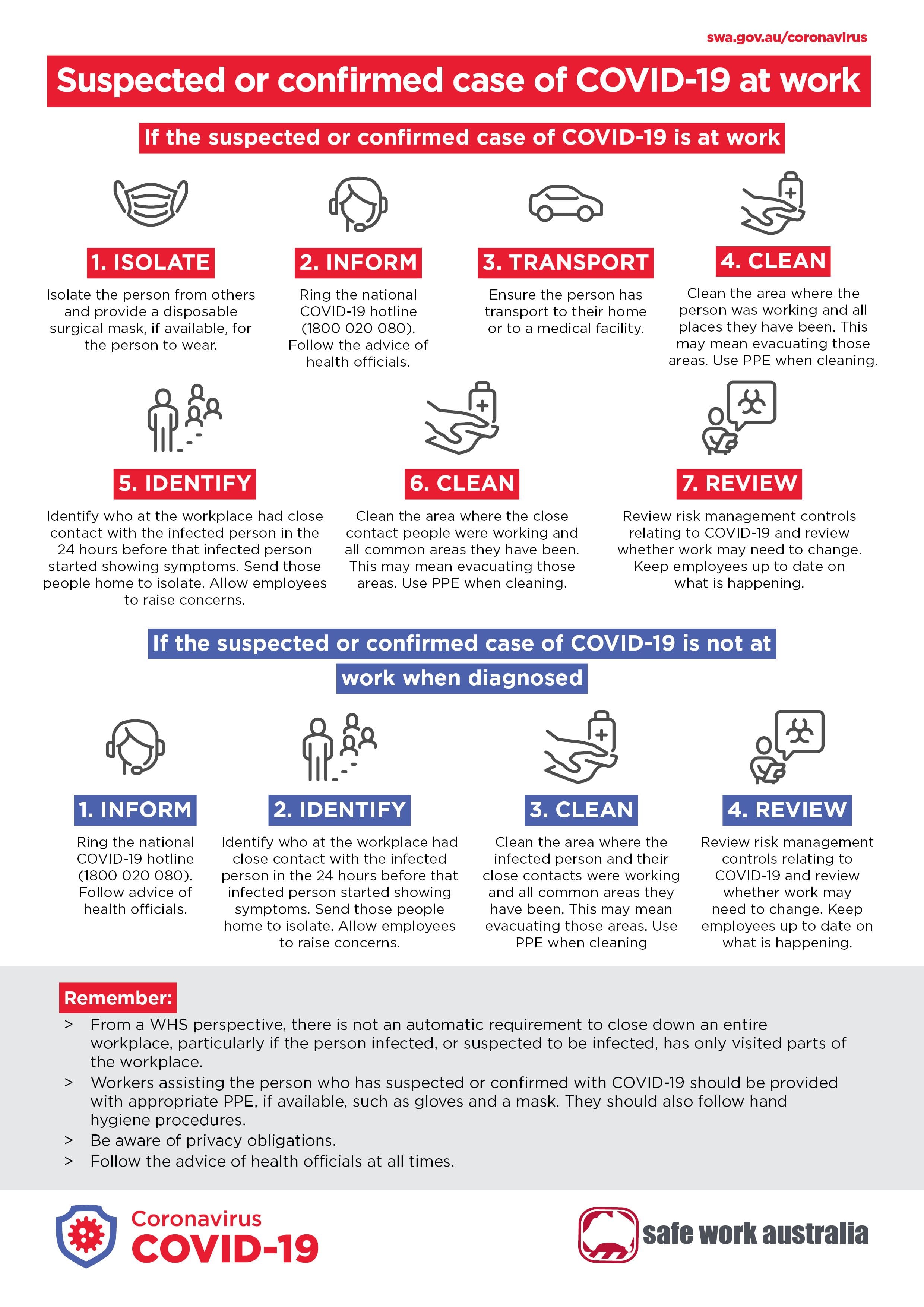
Professor Murphy also provided some advice to businesses that do find themselves in the situation where an employee does contract Covid-19.
He says Safe Work Australia has set out simple procedures at swa.gov.au/coronavirus where the organisation has detailed a response plan.
There are seven simple steps to follow that are detailed below:
Updated 2:07PM AEST on 7 April 2020.
ABS survey shows big shift to deliveries and online
 "ABS survey shows big shift to deliveries and online")
A survey from the Australian Bureau of Statistics (ABS) into the business impacts from Covid-19 has revealed some interesting trends, particularly around adaptation and negotiations with landlords.
In the second survey in relation to the effects of the pandemic on the business community, the ABS found close to two in five businesses (38 per cent) have changed how they deliver their products or services, including shifting to online services.
More than a third of businesses have renegotiated their lease and rental arrangements and a quarter have deferred loan repayments.
The bureau found two thirds (66 per cent) of Australian businesses reported that their turnover or cash flow had reduced as a result of the virus, and nearly half (47 per cent) had made changes to their workforce arrangements.
For some businesses this included temporarily reducing or increasing staff working hours, changing the location where staff worked (including working from home) or staff being placed on leave.
Related story: PM unveils mandatory commercial tenancies code
Updated at 12:24 AEST on 7 April 2020.
SCA Property to raise $300m for buying assets on the cheap
 "SCA Property to raise $300m for buying assets on the cheap")
While several ASX-listed companies are raising money to stay afloat or build resilience against uncertainty, Shopping Centres Australasia Property Group (ASX: SCP) is issuing new equity so it can snap up supermarket-anchored small shopping centres.
Last month SCP CEO Anthony Mellowes told Business News Australia the company's 85 neighbourhood shopping centres were thriving due to strong activity at Woolworths, Coles and Kmart, whose increased traffic in many cases helped lift sales for other retailers as well.
In an update today the company indicates this is still the case, with the expectation numerous Government stimulus packages should benefit its small business tenants and their customers.
SCP has formed the position the Covid-19 pandemic may provide a "unique opportunity to secure quality assets at competitive prices over the next 6-12 months", and in order to capitalise on that it will raise $300 million.
The raising will include a $250 million fully-underwritten institutional placement, as well as a $50 million non-underwritten unit purchase plan (UPP).
"With over $550 million in cash and undrawn facilities following the Equity Raising, we will be in a position to act quickly as earnings accretive opportunities arise," the company said.
The company's cash and undrawn debt facilities stand at $277 million prior to the raise, and it has also lifted its bilateral debt facilities by $100 million.
"We have a proven track record of securing and successfully integrating acquisitions in this market segment, where ownership remains fragmented," the group said.
"All but one of our 85 shopping centres are anchored by either a Coles or Woolworths supermarket, and as such our centres are benefitting from the elevated foot-traffic being generated by these anchor tenants over recent weeks.
"Our specialty tenants account for the other 52% of our gross rental income and are heavily weighted toward non-discretionary categories.
"Many of these specialty tenants are trading strongly, including pharmacies, medical centres, discounters, liquor and fresh food retailers."
Some of SCP's tenants have had to close down such as gyms, cinemas, massage, beauty, tanning salons and nail bars, but these represent approximately $1 million per month of the group's gross rental income.
In addition, cafés and restaurants - which are still able to offer takeaway services - represent approximately $700,000 million per month of our gross rental income
The company earns about $300 million in gross property income annually.
Other companies to announce capital raisings recently include Flght Centre (ASX: FLT), Webjet (ASX: WEB),Reece (ASX: REH) and Southern Cross Austereo (ASX: SXL).
Data centre operator NEXTDC (ASX: NXT) is also raising capital, but similarly to SCP this is due to heightened demand.
Updated at 11:13am AEDT on 7 April 2020.
Victorian students to learn from home after Easter break
 "Victorian students to learn from home after Easter break")
The Victorian Government has announced all government primary, secondary and special school students will move to remote and flexible learning and teaching when class recommences next week.
The drastic measure has been taken on the advice of the Chief Health Officer in order to slow the spread of Covid-19.
Victorian government schools will recommence on Tuesday 14 April with a pupil-free day, with students to begin classes on Wednesday 15 April. These new arrangements will remain in place for the duration of Term 2 and will then be reviewed.
"I know this year will be different to any that students, teachers and families have experienced before, but we are making sure that our kids still get the education they deserve," says Victorian Premier Daniel Andrews.
"We've done the work and planning so we're ready to make the move to remote and flexible learning, and I want to thank everyone involved for their dedication to our kids' education at this unprecedented time."
To support students the State Government has announced changes to the academic timetable for those in Year 12, as well as free Internet access and laptops for students in need.
VCE students will still receive an ATAR but there will be a number of chances to the academic timetable including:
- The GAT test will move from June to October or November;
- End of year exams will be postponed until at least December;
- School based assessment tasks will be reduced where possible to relieve some pressure on students as they move to remote and flexible learning arrangements; and
- Universities will be asked to delay the start of the 2021 academic year to account for impacts of coronavirus on senior secondary students.
VCE study scores will continue to be a combination of school-based assessment and external exams. VCAL students will have more time to complete their courses and this will be consistent with the revised dates for the VCE.
On-site learning will only be available for children whose parents can't work from home and vulnerable students without access to a suitable learning environment at home.
Further, the State Government will loan more than 6,000 laptops and tablets to students who currently do not have access to digital technologies at home. Schools will also distribute other classroom devices as required.
Free Internet access via SIM cards or dongles will be provided to thousands of students at public schools who need them the most. The State Government has partnered with Telstra to provide 4,000 SIM cards for public primary and secondary students.
The measure comes as Victoria reports 1,191 confirmed cases of Covid-19 in the state.
In total there are currently 5,895 confirmed cases of the coronavirus in Australia with 2,686 in NSW, 934 in QLD, 460 in WA, 411 in SA, 96 in the ACT, 89 in TAS, and 28 in NT.
Updated at 10:54AM AEST on 7 April 2020.
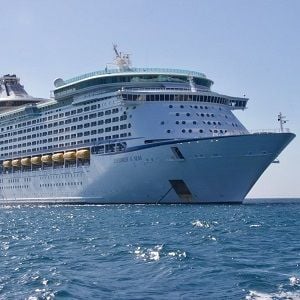
Queensland to send away foreign flagged cruise ships
 "Queensland to send away foreign flagged cruise ships")
The Queensland Government has announced all foreign-flagged cruise ships will be banned from entering its waters by midnight.
The move follows a national order from the Australian Border Force, and comes as a a criminal investigation is underway into the Ruby Princess as the largest single source of Australian Covid-19 infections, accounting for around 10 per cent of the total.
The Premier says the remaining four ships are just refuelling and "they'll be on their way as well".
Around 119 of Queensland's 934 coronavirus cases can be traced to cruise ship passengers.
There are currently 5,895 cases of Covid-19 in Australia and 45 deaths.
Although the amount of daily new cases has been declining the authorities have reiterated that is no cause for complacency. And with some states and territories yet to announce their numbers, it is looking like the decline will be less pronounced today if at all.
Updated at 10:38am AEST on 7 April.
Tabcorp stands down 700 staff as sport hiatus bites into betting
 "Tabcorp stands down 700 staff as sport hiatus bites into betting")
Australia's largest gambling company Tabcorp (ASX: TAH) has taken a battering from the cancellation of major sporting events and the shutdown of licensed venues and TAB agencies where so many of its clients like to take a punt.
New and obscure sport betting options like the Belarusian Premier League and Tajikstan men's basketball have been unable to compensate for loss of revenue that would normally come from the world's most popular competitions in Australia and worldwide.
This state of affairs has led the group to temporarily stand down more than 700 employees to 30 June 2020 in businesses where there is no work due to coronavirus-related closures.
A further 160 technology contractors have also been let go, representing a cut of 40 per cent.
Business-as-usual expenditure for the current half is expected to be down by a quarter at around $120 million, and Tabcorp has expanded its banking facilities through an additional $226 million short-term facility payable in mid-2021.
Managing director and CEO David Attenborough has also taken a 20 per cent fixed remuneration pay cut until the end of the financial year.
"This continues to be a very challenging time for our people, businesses, partners and the community," says Attenborough
"We are committed to working proactively and collaboratively with all our stakeholders so that we can collectively emerge from the Covid-19 period as strongly as possible."
Meanwhile, chairman and non-executive director fees have been reduced by 10 per cent, following on from an earlier 10 per cent cut in September last year.
Tabcorp highlights its Lotteries & Keno and Wagering & Media digital channels continue to operate, as well as the lotteries retail network of newsagents, convenience stores and other outlets.
Thoroughbred, harness and greyhound race meetings in Australia (excluding Tasmania) are currently still being conducted in accordance with strict state government biosecurity and public health restrictions.
Fees owed in April by venues under Sky Racing, TAB, Keno and MAX contracts have been suspended, and will be reviewed every month in light of Covid-19 developments.
Updated at 9:56am AEST on 7 April 2020.
CSL forms global alliance for Covid-19 plasma treatment
 "CSL forms global alliance for Covid-19 plasma treatment")
Australia's largest listed company CSL (ASX: CSL) has teamed up with Japan's Takeda Pharmaceutical Company and several international companies to develop a potential hyperimmune therapy for Covid-19.
The alliance formed by CSL Behring and Takeda to work on plasma-derived therapy for the virus now also includes Biotest, BPL, LFB and Octapharma.
Work will start immediately on the investigational development of an unbranded anti-SARS-CoV-2 polyclonal hyperimmune immunoglobulin medicine, which will be aimed at treating individuals with serious complications from Covid-19.
"Leaders lead during uncertainty. There is no question that we are all experiencing the impact of Covid-19," says CSL Behring executive vice president and head of research and development, Bill Mezzanotte.
"This effort aims to accelerate a reliable, scalable and sustainable option for caregivers to treat patients suffering from the impact of Covid-19.
"In addition to pooling industry resources, we will also collaborate with government and academic efforts as a single alliance whenever we can, including important activities like clinical trials. This will make it more efficient in these hectic times for these stakeholders as well."
The collaboration will leverage leading-edge expertise and work that the companies already have underway. Experts from the alliance will begin collaborating across key aspects such as plasma collections, clinical trial development and manufacturing. Further companies and institutions may join the alliance as well.
"Unprecedented times call for bold moves," says Takeda's plasma-derived therapies business unit president Julie Kim.
"We collectively agree that by collaborating and bringing industry resources together, we could accelerate bringing a potential therapy to market as well as increase the potential supply. We invite companies and institutions focusing on plasma to support or join our alliance," says Kim.
Developing a hyperimmune will require plasma donation from many individuals who have fully recovered from Covid-19, and whose blood contains antibodies that can fight the novel coronavirus.
Once collected, the "convalescent" plasma would then be transported to manufacturing facilities where it undergoes proprietary processing, including effective virus inactivation and removal processes, and then is purified into the product.
Updated at 9:21 AEST on 7 April 2020.
Advertisement
Latest News
From $13,000 to $20 million: how a PCOS diagnosis and a pair of scissors built Xali Organics
Inspired by a medical diagnosis and driven by innovative marketing,...
Cedar Woods secures $63.4m in new land acquisitions as record presales underpin pipeline push
Perth-headquartered residential developer Cedar Woods Properties (A...
Australia's long-term beer decline hits home as Lion plans to close Boag's brewery in Launceston
Australia's decades-long decline in beer consumption has claime...
Downer EDI seals $310m Transurban contract to maintain Sydney motorway network
Infrastructure services group Downer EDI (ASX: DOW) has secured con...
Propel Funeral Partners expands New Zealand footprint with trio of acquisitions worth $9.1m
Sydney-based death care provider Propel Funeral Partners (ASX: PFP)...
Advertisement