Advertisement
Staying informed is more important than ever as the situation unfolds with Covid-19. Stay tuned here for our live updates, and be sure to let us know what your business is doing to face this unprecedented challenge.
Covid-19 News Updates
The big dry: "Worst month on record" for alcohol sales
 "The big dry: \"Worst month on record\" for alcohol sales")
Despite polls showing more Australians turned to the drink at home to alleviate coronavirus-related stress, data from the industry has uncorked a a dramatic decline in volume due to the closure of pubs, clubs and bars.
A report released over the weekend from Alcohol Beverages Australia (ABA) demonstrates Zoom parties failed to make up for the decline in alcohol consumption that would normally take place at household gatherings.
"Despite some initial pantry filling in March, April has been the worst month on record for sales of beer, wine and spirits, consistent with ABS data showing consumption has fallen during the COVID-19 crisis," says ABA chief executive officer Andrew Wilsmore.
"The biggest category, beer saw a 44 per cent drop in April and cider saw the biggest decline at 61 per cent due to the loss of social occasions."
The ABA claims the decline in alcohol sales reflects the sad reality that almost half a million jobs have been lost in hospitality and around $8.5 billion in business revenue has dried up.
"Wine producers are also reporting volume losses of up to 70 per cent among small and medium sized enterprises who rely on restaurants as their main route to market," says Wilsmore.
"Major wine brands suffered a small decline in April before falling 16 per cent in the first two weeks of May."
The sudden closure of distillery doors and regional tourism in late March led to revenue declines of up to 80 per cent for local distillers.
Wilsmore says spirit volumes were down 21 per cent in April while ready-to-drink (RTD) beverages dropped 37 per cent, representing both a tale of woe and resilience.
"We knew that the total loss of trade from pubs, bars, clubs, and restaurants was never going to be made up for by a brief, small surge in panic buying during the week people were concerned bottleshops would also close," he says.
National polling in april conducted by YouGov Galaxy, commissioned by the Foundation for Alcohol Research and Education (FARE), showed 20 per cent of Australians purchased more alcohol and 70 per cent of them were drinking more alcohol than normal.
One third of respondents to the poll were drinking alcohol on a daily basis.

But Australian Bureau of Statistics (ABS) data illustrates the vast majority of people - more than than 85 per cent - are drinking responsibly during the pandemic, with their behaviours either unchanged or drinking less.
"The ABS data shows that 30 per cent of Australians are largely abstaining or not consuming alcohol; 47 per cent are drinking the same; and 10 per cent are drinking less. Only 14 per cent of Australians reported that their drinking had increased.," says Wilsmore.
"DrinkWise sought to dig deeper, commissioning independent research into Australian adults' experiences of purchasing alcohol and drinking at home, through a nationally representative sample of 1000 consumers.
"Of those who chose to drink, the research found that drinkers were maintaining average consumption of three standard drinks. Over the course of the week, this amounted to just over eight standard drinks in total - well within the official government guidelines."
He adds for Australians who reported their consumption of alcohol at home had increased, the vast majority continued to drink at moderate levels.
The industry representative explains his sector has been "the most severely impacted by the coronavirus pandemic".
"The loss of jobs and revenue in this sector has been crippling," he says.
"At the peak of isolation measures, 441,400 jobs had been lost in hotels, pubs, clubs, restaurants, cafes, takeaway, coffee shops, accommodation hotels and casinos. This represents a loss of a third of their total workforce.
"The hospitality sector has seen an $8.5 billion fall in revenue, which represents 10 per cent of their annual sales.
"The drinks industry was not immune to these employment effects, given its heavy reliance on hospitality and tourism, experiencing a 15.55% workforce decline that severely impacted the livelihoods of many Australians."
Updated at 12:20pm AEST on 25 May 2020.
Viva Leisure warms up ahead of gym reopenings
 "Viva Leisure warms up ahead of gym reopenings")
Viva Leisure (ASX: VVA) has drawn down almost half its cash reserves during the COVID-19 lockdown, but at least some of that money has been put to use revamping its gyms for future business.
In a release today the company said $5 million had been spent on pre-closure creditors, as well as the acceleration of refurbishments, completion of sites under development and business improvements.
After listing on the ASX in mid-2019, the Canberra-based group has expanded from 33 to 83 locations through expansion of its brands including Club Lime, Groundup, Gymmy Pt, Hiit Republic, Cycle Life and FitnFast, the latter acquired in mid-February.
In its release today the company highlighted the following upgrades:
-
Five of the 10 Queensland locations will re-open fully refurbished and with upgraded
equipment; -
Four locations currently under development/fit-out, two of which will be completed before
re-opening, with the remaining two being Nunawading, Melbourne (to be completed in July 2020), and
Pyrmont, Sydney (to be completed in late August 2020 at this stage); and -
Two new locations have completed during the shutdown and are ready to open (Gungahlin
Club Lime in ACT and Wagga Wagga Hiit Republic in NSW).
Viva Leisure now holds $6 million cash in the bank, excluding the May 2020 JobKeeper reimbursement which is expected to be approximately $950,000, as well as an undrawn overdraft facility of $6 million.
The company's Australian National University aquatic facilities already opened on Saturday, and the hydrotherapy facilities at the Canberra International Sports & Aquatic Centre were expected to open today.
Scheduled easings of restrictions on gyms in the ACT (30 May), QLD (12 June) and VIC (21 June) mean 70 per cent of Viva Leisure's locations have confirmed opening dates, while the group expects a NSW will be imminent. However, NSW Premier Gladys Berejiklian has today said the state government is not in a position to make an announcement on a return to business for gyms just yet.
Fitness, wellness and beauty facilities take stock as Covid-19 restrictions come into play
It is expected that Stage 2 will continue to have restrictions in place, likely to be 20 members within the gym, or different parts of each gym at one time, the final details are not yet known.
The company notes while any restriction on members is not ideal, it has implemented systems including bookings and automated people counters which restrict entry into the facility to assist with this short-term restriction. Members will be able to determine how busy each location is before attending outside of booked times.
Stage 3 of easing restrictions contemplates allowing 100 people in a gym at the same time, which would mean Viva can operate most facilities at full capacity.
"As we commence the tenth week of the mandatory shutdown of our clubs, our team has been working overtime to ensure we are ready to open our doors as soon as permitted to do so," says Viva Leisure's CEO and managing director Harry Konstantinou.
"It is promising to know that over 70 per cent of our locations could be open within the next three to four weeks, albeit with some initial restrictions.
"The feedback from members we have received during this shutdown is encouraging, with a large percentage of members keen to get back into it."
Konstantinou says data from reopened overseas clubs is encouraging, with the majority seeing higher than expected attendance and new member signups.
"While the mandatory shutdown is not something any business wants, it has allowed our team to reset, recharge and be ready to go.
"As expected, significant opportunities are now in front of us, and with our strong balance sheet, we will capitalise on them."
Viva has also successfully renegotiated deferrals or reduced rental payments for 25 locations, resulting in a saving of $444,000 per month on cashflow for up to six months.
The group is still negotiating on 58 locations, however it has not paid rent on them and various landlords are waiting for gyms to reopen so that any arrangement can be agreed.
VVR shares are up 4.74 per cent so far this morning trading at $2.43 each.
Updated at 11:27am AEST on 25 May 2020.
Accounting errors led to $60 billion overvaluation of JobKeeper
 "Accounting errors led to $60 billion overvaluation of JobKeeper")
The Treasury and Australian Tax Office (ATO) have drastically reduced their projected number of JobKeeper recipients by three million after it was revealed figures were inflated by mistakes on around 1,000 enrolment forms.
While these forms only represent 0.1 per cent of 910,055 submissions from businesses, they had a significant impact on the initial estimate that the program would cover around 6.5 million people.
Now that figure has been reduced to 3.5 million, just slightly above the 2.9 million employees working for 759,654 businesses with $8.7 billion in approved payments to date.
"The most common error was that instead of reporting the number of employees they expected to be eligible, they reported the amount of assistance they expected to receive," the two agencies said in a joint statement today.
"For example, over 500 businesses with '1' eligible employee reported a figure of '1,500' (which is the amount of JobKeeper payment they would expect to receive for each fortnight for that employee)."
The miscalculated projections had previously indicated around one in four Australians would be on JobKeeper, but that figure is now more like one in eight.
The Treasury has revised the estimated cost of the JobKeeper program program to $70 billion, whereas it would have been worth around $130 billion before.
Neither the ATO nor the Treasury gave any indication the unexpected $60 billion saving would translate to a longer period for JobKeeper, however hypothetically it would equate to an approximate 22-week extension for 3.5 million people.
"This reporting error has come to light as the ATO and Treasury have been analysing the amounts being paid out under the scheme, reconciling these with the estimates provided by enrolled businesses of the likely number of eligible employees," the agencies said.
"It was not picked up by the ATO earlier as their primary focus in the first fortnight of JobKeeper payments was on ensuring that JobKeeper payments were paid promptly to those eligible for them, and not paid to those who were ineligible.
"These initial estimates from businesses of employees covered are not linked to payments, and so were not as carefully analysed."
The Treasury and ATO emphasise the reporting error has no consequences for JobKeeper payments that have already been made to eligible businesses.
The reason the impact is inconsequential for individual businesses is that payments are based on declarations made in relation to each and every employee.
"This declaration does not involve estimates and requires an employer to provide the tax file number for each eligible employee.
"By contrast, the only use of the information collected in respect of the reporting error was to provide an early estimate of the number of expected employees likely to access the JobKeeper program."
The agencies estimate around 150,000 enrolled businesses are yet to complete their employee declaration, which is required before payments can be made.
"Employers can still apply up to 31 May for payments made in April. Moreover the program will remain open to businesses that meet the eligibility criteria at any time over the 6 months it is in operation.
"JobKeeper is a demand driven program which was designed to support eligible employees in businesses that have experienced a significant fall in their turnover."
The agencies explain the original estimate was developed at a time when COVID-19 cases were growing significantly in Australia and restrictions were being tightened across Australia and much of the world.
"The difference between Treasury's estimates at the time and the number of employees now accessing the JobKeeper program partly reflects the level and impact of health restrictions not having been as severe as expected and their imposition not having been maintained for as long as expected at the time," the ATO and Treasury said.
"This has been reflected in some improvement to the outlook for the economy since the original estimate was developed as a consequence of these and other factors.
"The variation in estimates also reflects the inherent uncertainty associated with estimating the take-up of a demand driven program in the current circumstances."
What the reporting error doesn't change is the state of the labour market or the Treasury's projections for it. One in three Australians has either lost their job or had their working hours reduced since the pandemic began, 489,800 people have left the labour force, and unemployment rose by one percentage point to 6.2 per cent from March to April.
"It remains the case that in the absence of the JobKeeper program, Treasury expects the unemployment rate would have been around 5 percentage points higher," the agencies said.
"Treasury continues to expect the unemployment rate to reach around 10%, although as indicated by last week's Labour Force survey, the measured level of the unemployment is highly uncertain given the impact of social distancing restrictions on the participation rate."
The ATO has reminded employers they must declare their eligible employees monthly on an ongoing basis in order to receive JobKeeper payments, with May declarations having to be made by the 14 June.
The Treasurer also highlighted today that ratings agency Fitch has reaffirmed Australia's AAA credit rating, representing an expression of confidence in the Morrison Government's handling of the coronavirus crisis, as well as its demonstrated record of economic management and "commitment to fiscal prudence".
"Today's report confirms Australia as one of only 10 countries with a AAA credit rating from all three major ratings agencies," Treasurer Frydenberg said.
"In its report, Fitch notes that Australia's "effective macroeconomic policy framework, has supported a long record of stable economic growth prior to the current exogenous shock" and that "substantial fiscal and monetary policy stimulus" has been put in place "which should soften the shock and support the economic recovery"," he said.
"Fitch's action today, in reaffirming our AAA rating, is a reminder of the importance of maintaining our commitment to medium term fiscal sustainability."
Updated at 3:25pm AEST on 22 May 2020.
Up to 50 patrons allowed in NSW pubs, restaurants and cafes from 1 June
 "Up to 50 patrons allowed in NSW pubs, restaurants and cafes from 1 June")
From 1 June up to 50 patrons will be allowed in New South Wales pubs, restaurants, clubs and cafes.
Strict regulations will be enforced on hospitality businesses, and those that are non-compliant will face the possibility of being closed down once again.
The four square metre per person rule will still apply, and customers at venues must be seated to be served.
Shared food, drinks and cutlery will be off the table for the time being in order to maintain strict hygiene standards.
Premier Gladys Berejiklian says the announcement is a major step for the state.
"New South Wales will be taking an important, critical and big step from the first of June," Berejiklian said.
"But the regulations and rules we will be putting in place will be very strict to make sure safety is paramount.
"And we have a no regrets policy, firstly in keeping the community safe, making sure everything we do is to protect lives and save lives, but also in relation to making sure people aren't long term unemployed, and that we can bounce back from the devastating economic shock."
These lifted restrictions on pubs, cafes and restaurants will come into force on the same day that the state is easing restrictions on intrastate travel.
Deputy Premier John Barilaro says the eased restrictions will be welcomed not only by businesses in Sydney, but also by regional areas where hospitality companies are gearing up for the long weekend and an influx of intrastate travellers.
"Today's announcement will allow regional businesses and economies to embrace, with the opening up of travel, the opportunity for businesses right into the June long weekend to fill their registers," Barilaro said.
"We know this industry is so important, right across the state. More than a quarter of a million people are employed in the hospitality sector, and we know, with the losses that we've seen in employment, this is a sector that could quickly put jobs back into the economy, and that is why the New South Wales Government ... are taking a mighty big step to make sure that our venues can open to embrace the visitors to come to regional and rural New South Wales."
Related: Three more months under current conditions the limit for nearly half of restaurants
NSW is the first state to go to 50 patrons in a venue, and follows announcements from Victoria and South Australia where the patron limit is slowly rising.
South Australia today will allow up to 20 patrons in a venue - 10 seated inside and 10 seated outside - and restaurants and cafes will be allowed to serve alcohol. Pubs in the state will be permitted to reopen on 5 June, but guidelines regarding numbers of patrons are yet to be announced.
Victoria announced on 17 May that from 1 June pubs, cafes and restaurants will be permitted to reopen with a 20-customer limit.
The announcement comes as NSW reports three new cases of COVID-19 today, bringing the state's total to 3,084.
Victoria has reported 12 new cases today, and Queensland zero new cases, bringing the national total to 7,095.
In total, 6,481 people have recovered from the coronavirus, with eight new recoveries today.
There are currently 509 active cases of COVID-19 in Australia.
Updated at 1:15pm AEST on 22 May 2020.
Three more months under current conditions the limit for nearly half of restaurants
 "Three more months under current conditions the limit for nearly half of restaurants")
New research released today by hospitality service provider Silver Chef and research group InKind reveals just 52 per cent of restaurant owners believe they can survive the next three months.
If current COVID-19 restrictions stay in place confidence for survival will deteriorate as time progresses.
Just 67 per cent of surveyed owners think their businesses can see out another month under the current COVID-19 conditions.
Faith fades as time goes on, with 60 per cent saying they can survive another two months from today, and only 52 per cent for another three months.
These concerning figures are complemented by the finding that the majority of restaurant owners (75 per cent) believe that it will be longer than six months before business returns to pre-COVID-19 levels.
According to Silver Chef's research Australian restaurants and other hospitality businesses chose to fight on during the worst of restrictions.
Just three in 10 businesses completely closed during COVID-19, with 63 per cent still operating as either pickup and/or delivery.
Hot food (56 per cent) and beverages (43 per cent) are the key products being offered via takeaway and delivery, but close to a third chose to provide produce/deli items and cook it yourself meals as an option.
More than a third of hospitality businesses have been operating with less than 10 per cent of their usual teams, with 70 per cent of businesses have accessing JobKeeper to remain in operation.
There is hope on the horizon though as Australian states begin to allow restaurants and other hospitality businesses to reopen under customer number limitations.
These limitations are likely to be eased as the COVID-19 situation gets better.
Interestingly, both the South Australian and Victorian Premiers have noted recently that allowing hospitality businesses to reopen with just ten patrons is unrealistic from a financial point of view for most restaurants, bars and cafes.
This change in the landscape has been reflected by Silver Chef's research, with 71 per cent of businesses believing that innovation will be critical moving forward, with the hospitality industry as a whole needing to become more creative to entice customers to spend.
40 per cent of surveyed owners actually believe that their business will become more resilient in the future because of how COVID-19 has forced them to implement diversified revenue streams (e-commerce and takeaway being two key new streams) that were put in place during lockdowns.
Updated at 12:08pm AEST on 22 May 2020.
NT hits milestone with zero active cases of COVID-19
 "NT hits milestone with zero active cases of COVID-19")
The Northern Territory has today announced there are zero active cases of COVID-19 within its jurisdiction.
While this is certainly a milestone for Territorians to celebrate, Health Minister Natasha Fyles has stressed complacency is not an option.
Speaking at a press conference this morning, Fyles said it had been six and a half weeks since the Territory's last diagnosed case of COVID-19.
"We are a safe bubble and we need to keep it that way," says Fyles.
"We have a very vulnerable community, a very vulnerable population particularly with our Aboriginal Territorians and so I urge all Territorians to not become complacent off the back of this."
Fyles' update comes just under two weeks before the NT plans on easing intra-territory travel, which will allow residents to move around the Territory.
Despite pressure from other state governments Fyles says that travel into the NT from other Australian states is not something on the table just yet.
"We must remain vigilant," says Fyles.
"During that time, we know that coronavirus spreads so quickly and because symptoms are so mild people don't realise that they have coronavirus and they could be spreading it in our community.
"As time goes on we will see those measures around interstate travel and international travel ease, but it will be based on clinical advice around this virus."
The news comes as the total number of confirmed COVID-19 cases globally have surpassed 5 million.
In Australia there are 7,081 total confirmed cases of the coronavirus, including six new cases confirmed today.
A total of 6,473 people have recovered from COVID-19 in Australia, and there are 504 total active cases.
Photo via jeremydxg on Flickr.
Updated at 10:04am AEST on 21 May 2020.
April sees sharpest fall in retail turnover on record
 "April sees sharpest fall in retail turnover on record")
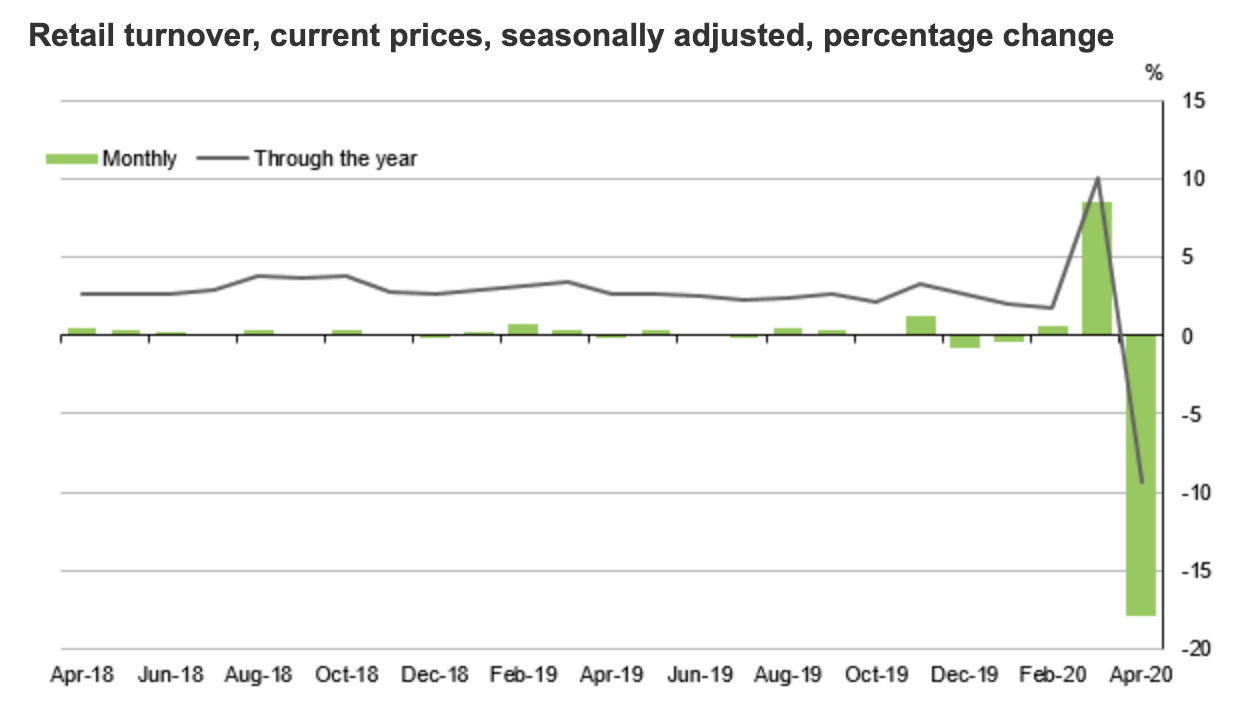
April's retail trade figures released by the Australian Bureau of Statistics today show the strongest seasonally adjusted fall ever published.
Retail turnover fell by 17.9 per cent in April 2020, and follows the strongest ever seasonally adjusted rise in March 2020 which was largely the result of stockpiling.
Not a single retail sector was spared, with particularly strong falls recorded in food retailing, cafes, restaurants, clothing, footwear and personal accessories.
The figures are the direct result of COVID-19 restrictions implemented nationally in a bid to slow the spread of infections of the coronavirus.
While March saw a mix of impacts related to COVID-19 across industries, these impacts were overwhelmingly negative in April, as regulations regarding social distancing measures limited the ability of businesses to trade as normal for the entire month," says the ABS.
"Cafes, restaurants and takeaway food services, clothing, footwear and personal accessory retailing, and department stores fell heavily in April and there were no offsetting rises in the other industries.
"Turnover in clothing, footwear and personal accessory retailing, and cafes, restaurants and takeaways is around half the level of April 2019."
The food retailing sector, which saw a significant rise in March due to "unprecedented" demand, fell 17.1 per cent in April.
Via: ABS
In seasonally adjusted terms Australian retail turnover fell 9.4 per cent in April 2020 compared with April 2019.
Analysis of supermarket and grocery store scanner data shows that monthly retail turnover fell in original terms for non-perishable goods, perishable goods and all other products by 23.7 per cent, 15.3 per cent and 24.5 per cent respectively in April 2020 compared to March 2020.
These falls follow significant unprecedented demand in March 2020 where non-perishable goods rose 39 per cent, perishable goods rose 21.6 per cent and all other products rose 30.5 per cent.
Turnover in clothing, footwear and personal accessories in April 2020 was around half the level of April 2019.
Updated at 2:47PM AEST on 20 May 2020.
South Australia to lift restrictions earlier than planned
 "South Australia to lift restrictions earlier than planned")
After reporting zero active cases of COVID-19 in South Australia on Friday, the State Government has decided to accelerate its plan to lift restrictions.
From Friday restaurants and cafes will be able to entertain 20 guests - 10 seated inside and 10 seated outside - and serve alcohol.
SA will also be moving to its second stage of easing restrictions earlier than planned.
Stage 2 will now come into effect on Friday 5 June, three days earlier than originally envisioned.
The specifics of what exactly will be allowed on 5 June are still being organised by medical officials and will be announced closer to the date, but the State Government has confirmed that all pubs across the state will be permitted to open.
The Premier says the lifting of restrictions on 5 June will be outlined in a "principles-based approach" in the coming days.
The changes will mean more SA businesses are able to operate over the June long weekend.
"I think everybody knows that we have done extraordinarily well in Australia in managing the health crisis and in particular in South Australia we have done an outstanding job," Premier Steven Marshall said this morning.
"We know that the economic crisis is really hitting the people of our state, the businesses of our state, the families here in South Australia; people have lost jobs. So we really have got to get the balance right."
"We have listened to what the people of South Australia have they want to move to stage two sooner than the Monday of the long weekend. We know that it would be great for regional South Australia. We know it would be great for businesses in metropolitan Adelaide."
The South Australian Roadmap for easing COVID-19 restrictions has been updated. STEP 1: Indoor and outdoor dining allowed at cafes and restaurants (10 indoors/10 outdoors) from 22 May. STEP 2: Changes will come into effect from 5 June. Updated roadmap: https://t.co/yg2v6rmuWTpic.twitter.com/Dn3y48ykVX
SA Health (@SAHealth) May 20, 2020
When the State's roadmap for easing COVID-19 restrictions was announced earlier this month Stage 2 envisioned the reopening of the following with a capacity of 20 people:
- Cinemas and theatres
- Seated dining
- Galleries and museums
- Beauty, nails, tattoo, massage (non-therapeutic)
- Driving instruction lessons
- Gyms and indoor fitness
- Funerals (50 max)
- Sports transition to competition without spectators, including indoor sports
The announcement comes as Australia only has nine people in ICU for COVID-19 treatment.
1.1 million tests have been conducted, and there have been 11 new cases of COVID-19 today to a total of 7,079. Four of these cases were in NSW, seven in VIC, and one in QLD.
Updated at 11:48am AEST on 20 May 2020.
Sydney Airport traffic crashes 97.5 per cent
 "Sydney Airport traffic crashes 97.5 per cent")
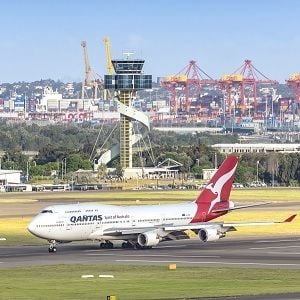
Traffic figures released today by Sydney Airport (ASX: SYD) reveal a drastic fall in passenger numbers in April due to travel restrictions relating to the COVID-19 pandemic.
The airport reports total traffic fell 97.5 per cent year-on-year to 92,000 passengers, of which 43,000 were domestic and 49,000 were international.
The reduction for domestic travel was slightly more pronounced at 97.9 per cent, compared to the 96.9 per cent fall for international travellers.
But what is also telling about this crisis is that the number of domestic passengers was only slightly higher than for their international counterparts, whereas normally the figures for domestic are almost two-thirds higher.
"We expect the downturn in passenger traffic to persist until government travel restrictions are eased," the airport said.
Australians continued to be the leading nationality of passengers, followed by the UK which was ranked fifth in April 2019. China fell one spot to third in terms of nationality, and was followed by South Korea (7th in April 2019) and Germany (outside Top 10 in pcp).
The Top 10 nationalities travelling through the airport is completed by Japan, France, the USA, Canada and New Zealand, the latter holding third place this time last year.
According to an update released last month, Sydney Airport has a combined liquidity of $2.8 billion split by $430 million in available cash, $1.75 billion of undrawn bank facilities and approximately $600 million of new USPP bond market debt.
"This is comfortably in excess of the $1.3 billion of debt maturing in the next 12 months and the $150 million to $200 million of expected capital expenditure over the same period. We also expect to remain compliant with our covenant requirements," the group said at the time.
"Given the strength of our balance sheet and liquidity position, at this time we do not see the need to raise equity."
Photo: Kurt Ams
Updated at 10:26am AEST on 20 May 2020.
Intrastate travel restrictions to be lifted from 1 June in NSW
 "Intrastate travel restrictions to be lifted from 1 June in NSW")
NSW Premier Gladys Berejiklian has encouraged residents to get out and visit the state's regions when intrastate travel restrictions are lifted on 1 June.
Timed just one week before the Queen's Birthday long weekend, Berejiklian hopes people will take a "well-earned holiday" and stimulate the state's hardest hit regions.
"This is the day we've all been looking forward to since the COVID-19 travel restrictions were put in place earlier this year and I would like to thank everyone for their patience during the past few months of being cooped up at home," Berejiklian said.
"I must stress to everyone that, while we want people to enjoy a well-earned holiday, we must do this responsibly and continue to abide by physical distancing measures, as the last thing we want is further outbreaks that will force us to reintroduce restrictions."
Deputy Premier John Barilaro says the lifting of intrastate travel restrictions will be welcomed with open arms by communities in NSW who have been decimated by both the bushfires and now COVID-19 restrictions.
"COVID could not have come at a worse time for regional NSW, with towns already doing it tough due to bushfires and drought and so I encourage everyone to make plans to safely and responsibly visit their favourite regional holiday destination, or discover a new one," Barilaro said.
"I encourage holidaymakers to visit local businesses, enjoy local attractions and feast on the best food regional NSW has to offer, and for those not able to get away in June, to start making plans for later in the year when even more businesses will be open.
"I'm very pleased to share that this means we will have a ski season this year, however holidaymakers should be aware that ski resorts will likely need time to put COVID plans into place and you should make contact before visiting."
In addition to intrastate travel restrictions being lifted, museums, art galleries and other cultural institutions will reopen on 1 June.
Berejiklian has once again emphasised that NSW's borders are still open, saying it is imperative that the State's economy keeps on ticking.
"Of course, New South Wales is always open to welcome people from other states, we intend to keep our borders open," says Berejiklian.
"We think that's best for New South Wales but also best for Australia and we will play our part as the largest state, as traditionally the economic powerhouse of the nation, to make sure we generate as much economic activity as possible in a safe environment."
Berejiklian says the decision to lift intrastate travel restrictions comes as the data being recorded about COVID-19 infections proves to be promising.
"At this stage the numbers are so small that we're very comfortable with the steps we're taking," says Berejiklian.
"Even the community transmission is less than what we anticipated at this time.
"But it doesn't come without risk, and our measure of success shouldn't be a small number of cases every day because we won't be able to maintain that."
Updated at 9:46am AEST on 20 May 2020.
Advertisement
Latest News
From $13,000 to $20 million: how a PCOS diagnosis and a pair of scissors built Xali Organics
Inspired by a medical diagnosis and driven by innovative marketing,...
Cedar Woods secures $63.4m in new land acquisitions as record presales underpin pipeline push
Perth-headquartered residential developer Cedar Woods Properties (A...
Australia's long-term beer decline hits home as Lion plans to close Boag's brewery in Launceston
Australia's decades-long decline in beer consumption has claime...
Downer EDI seals $310m Transurban contract to maintain Sydney motorway network
Infrastructure services group Downer EDI (ASX: DOW) has secured con...
Propel Funeral Partners expands New Zealand footprint with trio of acquisitions worth $9.1m
Sydney-based death care provider Propel Funeral Partners (ASX: PFP)...
Advertisement